Two Houses, One Olive Grove: How Much Would It Cost to Build a Private Estate for a Married Couple Who Choose to Live Separately?
A Different Way to Build a Life Together
What if marriage did not mean sharing the same front door, the same living room, or even the same house? This property explores a different idea: two independent homes, one shared olive grove, and enough space for a couple to enjoy both togetherness and personal freedom.
Set among thousands of olive trees in a peaceful rural landscape, the estate is divided into two separate residential compounds. Each has its own perimeter fence, entrance, driveway, buildings, and outdoor space. The two properties sit close enough to make visiting easy, but each household can maintain its own routines and privacy.
The concept is not about living apart emotionally. It is about creating a shared life without giving up the comfort of having a place entirely your own.
My House: A Traditional Home with Room to Work and Relax
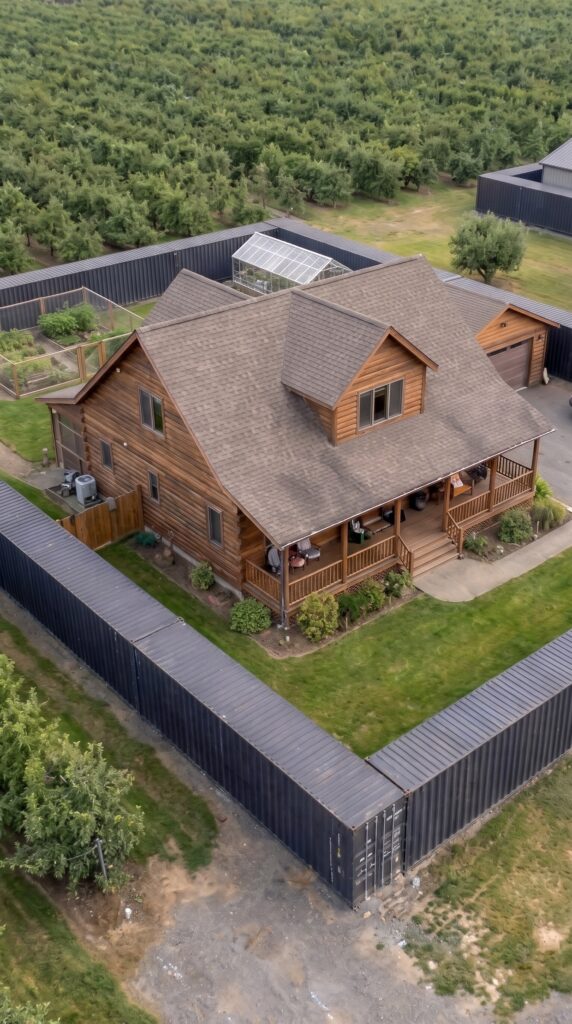
The first property belongs to the husband. At its center stands a spacious wooden house with a traditional rural design, warm timber exterior, a large roof, and a covered front porch. It feels like a permanent family home rather than a temporary countryside cabin.
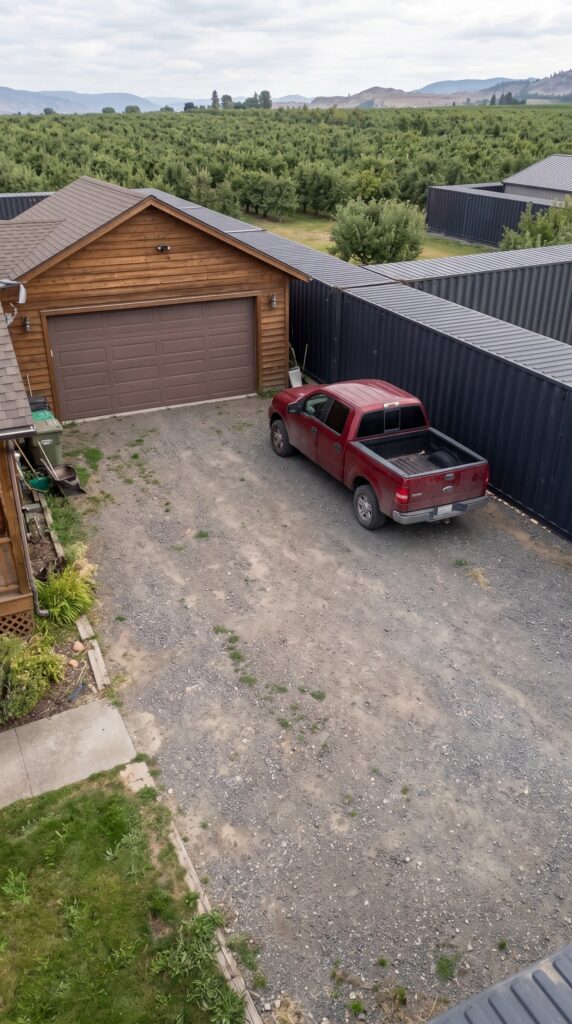
The house is surrounded by a neat lawn, landscaped planting areas, and a private gravel driveway. A garage is connected to the main building, providing protected parking and storage for tools, equipment, and everyday supplies.
A red pickup truck sits outside, ready for trips around the property, transporting materials, collecting harvests, or visiting nearby towns. The garage also provides space for routine vehicle maintenance and storing gardening equipment.
The layout leaves enough open yard space for outdoor seating, a small workshop, and practical projects without making the property feel crowded.
My Wife’s House: A Modern Private Retreat
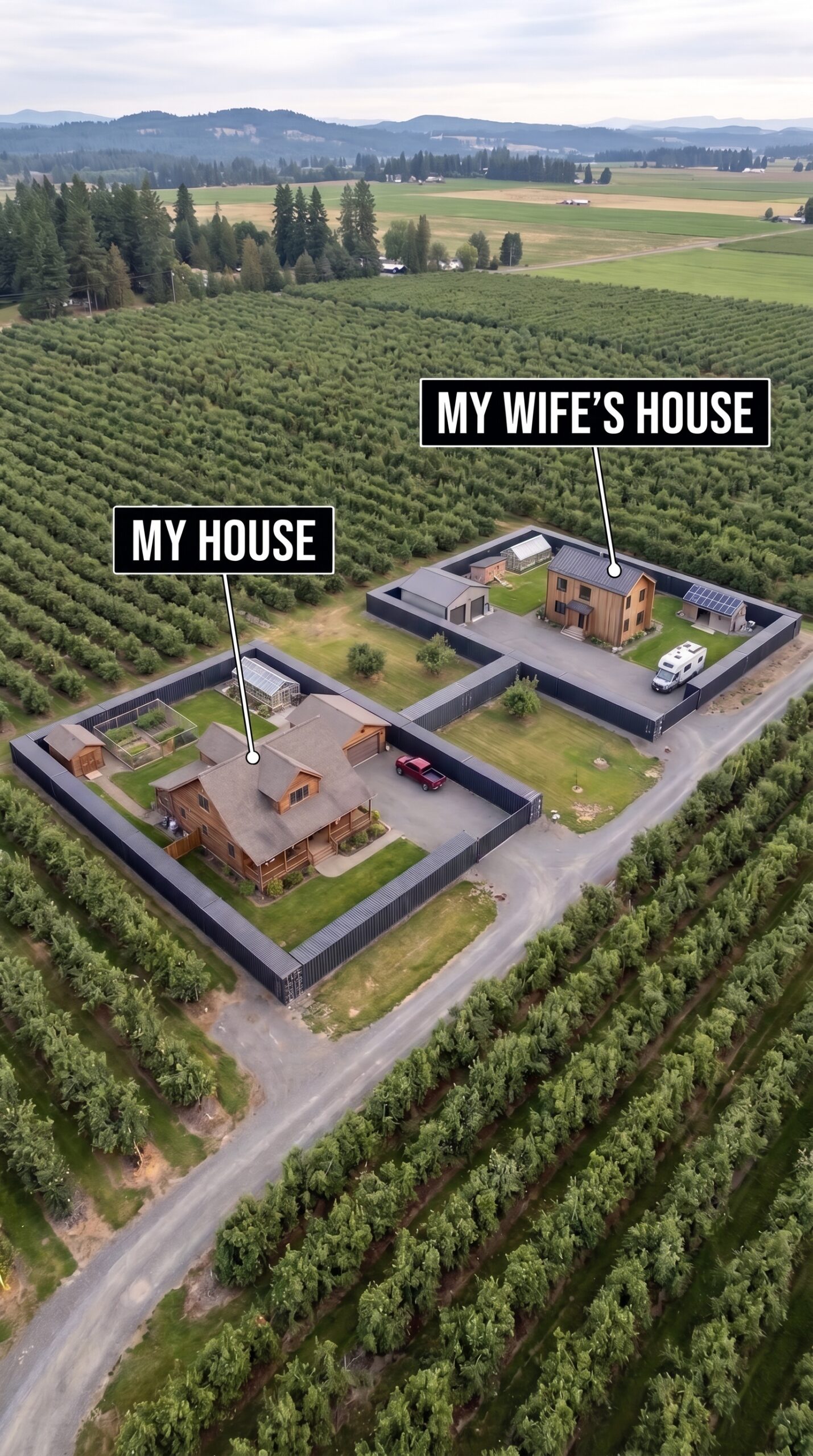
Across the shared rural landscape is a second, independent compound: my wife’s home. Its design is noticeably different from the traditional wooden house on my side.
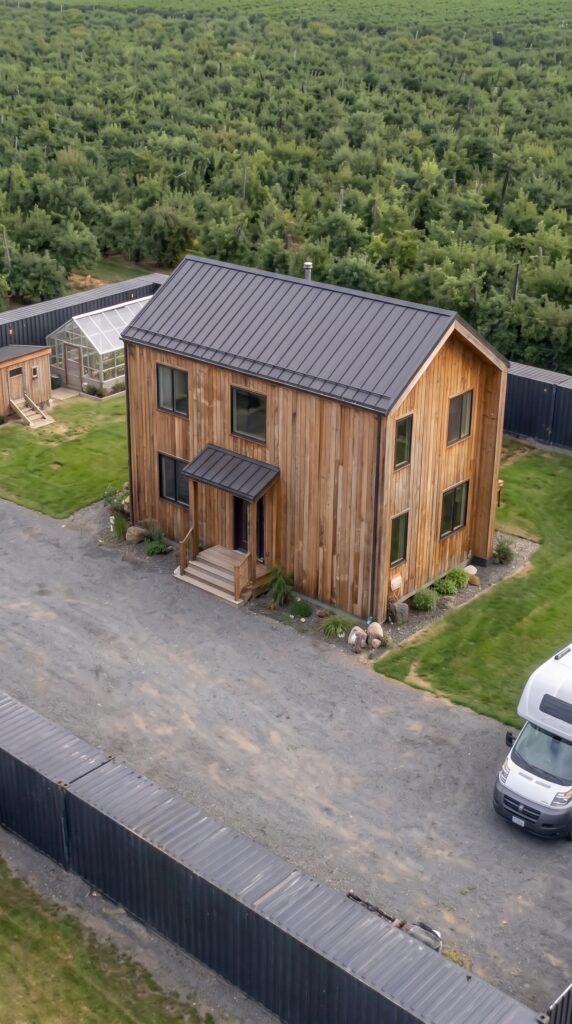
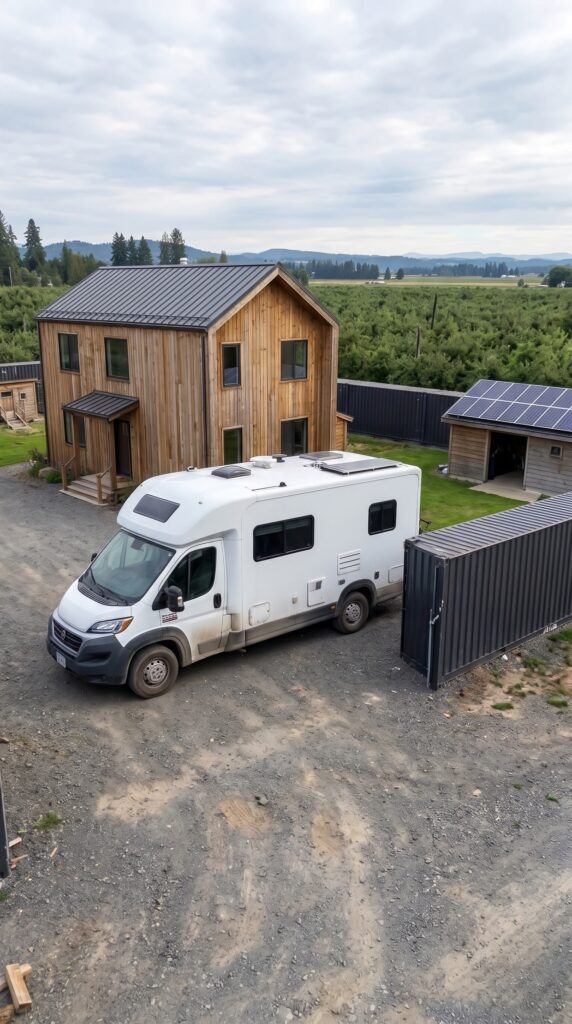
Her two-story wooden residence has a clean, modern appearance, vertical timber cladding, dark-framed windows, and a simple metal roof. The architecture is more contemporary, with a compact footprint and a private entrance.
The surrounding yard includes its own driveway, a small outbuilding, and a solar-panel installation. A white motorhome is parked nearby, creating an additional option for travel or temporary accommodation when guests arrive.
The motorhome is not just decoration. It can serve as a flexible living space during renovations, a base for road trips, or a comfortable place to stay when someone wants a change of scenery.
The important detail is that this is a complete second household. My wife does not have to treat one room in my house as her private space. She has her own home, her own entrance, and her own daily routine.
Two Separate Properties, Two Independent Yards
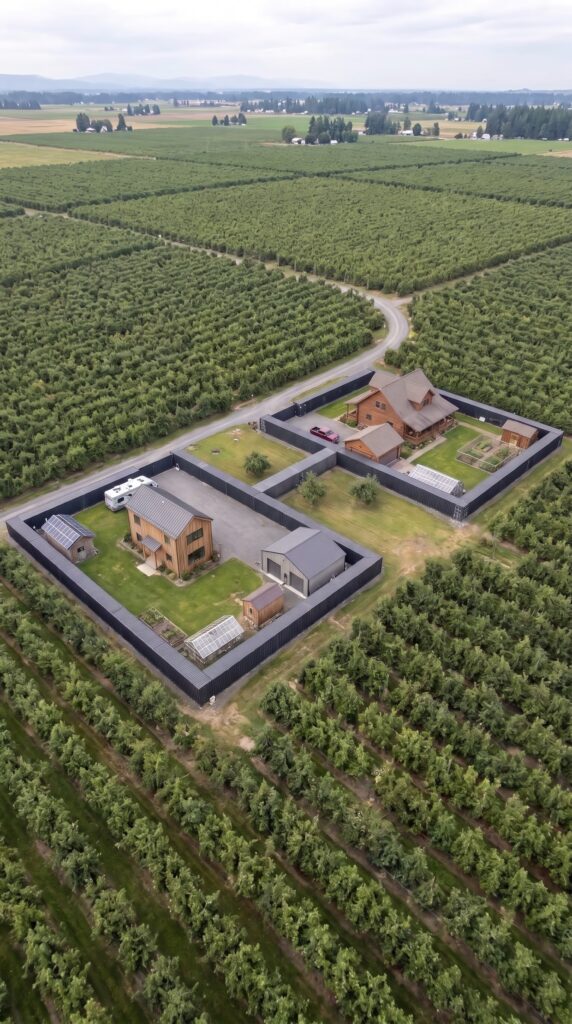
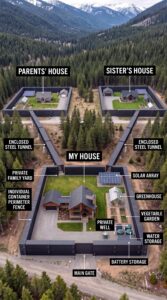
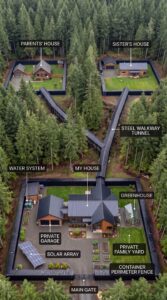
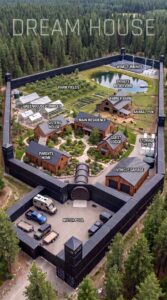
The aerial view reveals the most important feature of the design: the two homes are surrounded by separate dark perimeter fences.
Each compound has a defined boundary and its own access from the rural road. The fences provide privacy, help keep pets and livestock within the property, and make it easier to manage each yard independently.
The two compounds are positioned close to one another, with the olive grove extending around them. This arrangement makes it possible to walk between the houses while keeping the residential areas separate.
There is no need to coordinate every small decision about the yard, parking, storage, or outdoor activities. Each person can organize their own space according to their preferences.
The design also leaves room for future improvements, such as covered outdoor seating, additional storage, workshops, or a shared recreation area.
Heated Greenhouses for Year-Round Growing
Both properties include a greenhouse, allowing each household to grow vegetables, herbs, and seedlings in a controlled environment.
A heated greenhouse can extend the growing season considerably, especially in regions where winter temperatures limit outdoor production. Tomatoes, cucumbers, peppers, leafy greens, and herbs can be grown at different times of the year, depending on the climate and available heating system.
The greenhouse on each property also creates a practical backup for food production. It will not make the estate completely self-sufficient, but it can reduce grocery purchases and provide a reliable supply of fresh produce.
Heating, ventilation, irrigation, insulation, and temperature monitoring all need to be considered during construction. A greenhouse is only useful year-round if its operating costs and energy requirements are planned properly.
Chicken Coops and Fresh Eggs
Each household also has its own small chicken coop and outdoor enclosure.
Keeping chickens provides a regular supply of fresh eggs, provided the flock is properly cared for and supplied with feed, clean water, shelter, and protection from predators. The surrounding yard offers room for a secure run and a small storage area for feed and equipment.
Having two separate coops means that each household can manage its own flock. Alternatively, the couple could keep one shared flock and divide the responsibilities.
It is a small feature, but it contributes to the overall rural lifestyle: fresh eggs in the morning, vegetables from the greenhouse, and a little more independence from supermarkets.
Thousands of Olive Trees: The Shared Resource
The most valuable visual feature of the estate is the olive grove surrounding both properties.
Rows of mature olive trees stretch across the landscape, creating a green agricultural setting and giving the two homes a sense of privacy. Instead of looking directly into neighboring houses, the residents are surrounded by cultivated land.
The olive trees also offer the possibility of seasonal income. Depending on the variety, climate, tree age, irrigation, and local growing conditions, the harvest could be sold to a local mill or processed into olive oil.
However, an olive grove requires ongoing work. Trees need pruning, pest management, soil care, and sometimes irrigation. Harvesting can be labor-intensive, and the final quantity of oil depends heavily on the season and the condition of the trees.
For the couple, the grove could become a shared long-term project. They could manage the land together while keeping their everyday residential lives independent.
The Olive Grove: A Family Farm That Can Generate Income
The olive trees surrounding the two properties are more than a beautiful landscape feature. With approximately five acres dedicated to olive cultivation, the estate could become a small agricultural business producing its own extra virgin olive oil.
A mature five-acre grove might contain approximately 500–700 trees, depending on planting density and the varieties selected. Once the trees reach productive maturity, a reasonable planning scenario would be around two tons of olives per acre, or approximately ten tons of fruit in a good harvest year.
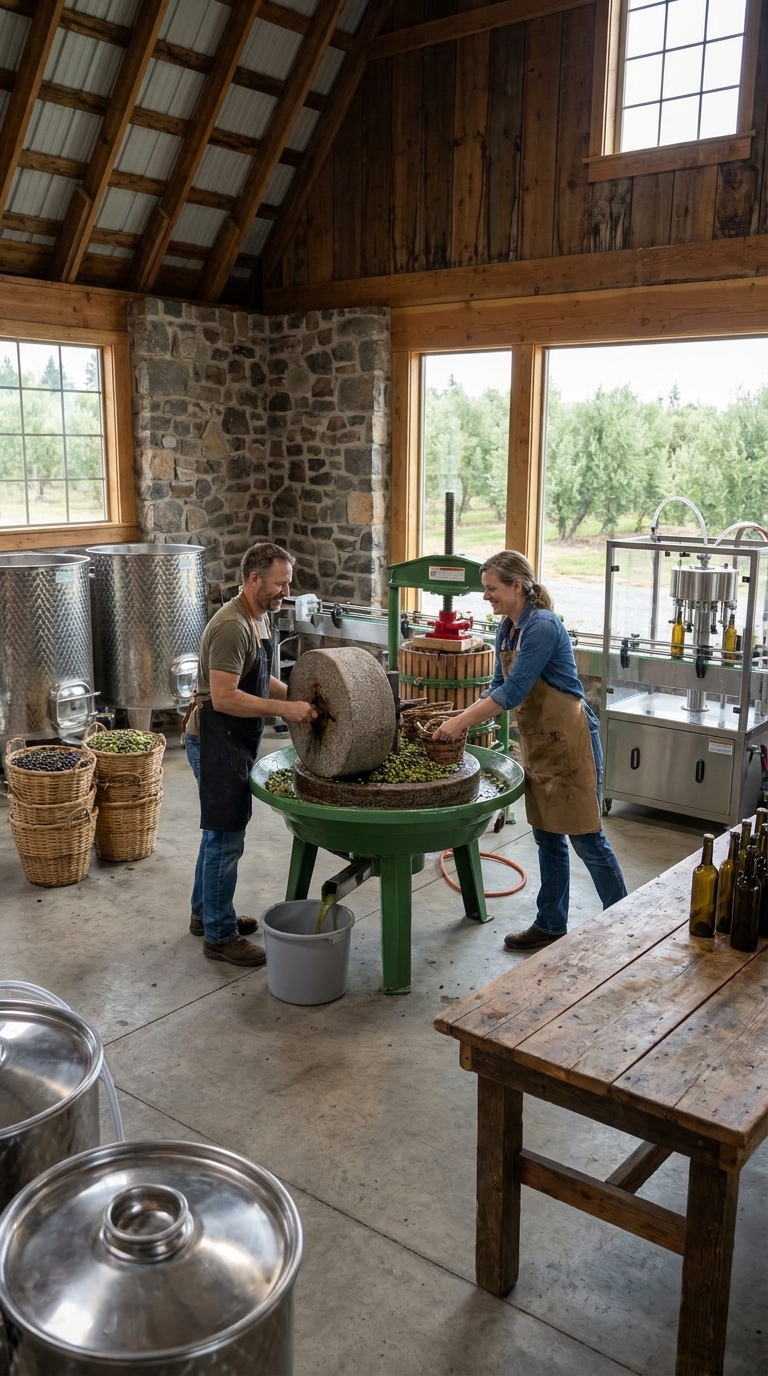
The olives would be collected during the harvest season and transported quickly to an olive mill. There, the fruit would be cleaned, crushed, mixed, and separated into oil, water, and solid by-products. The resulting oil could then be filtered, stored in stainless-steel tanks, and bottled under a family-owned brand.
How Much Olive Oil Could the Grove Produce?
For planning purposes, assume that each ton of olives produces approximately 30–40 gallons of oil. Actual extraction varies according to the olive variety, ripeness, moisture content, and processing equipment.
With ten tons of olives, the estimated annual production would be:
Olives harvested: approximately 10 tons
Olive oil produced: approximately 300–400 gallons
Equivalent volume: approximately 1,135–1,515 liters
500 ml bottles: approximately 2,270–3,030 bottles
That is enough to create a small but meaningful premium product line. The couple could sell the oil in 500 ml bottles, offer larger containers to local customers, supply restaurants, or keep part of the production for their own household.
How Much Money Could It Generate?
There are two different business models.
The first is selling the extracted oil in bulk to a buyer or distributor. This requires less investment in packaging and marketing, but the selling price is lower.
The second is bottling and selling the oil directly under a private family brand. This can generate higher revenue per liter, but requires bottles, labels, storage, marketing, distribution, and time spent finding customers.
For a simple planning model, assume the mature grove produces 300–400 gallons of oil annually:
Bulk or farm-gate sales at an illustrative $9–$12 per gallon: approximately $2,700–$4,800 in gross annual revenue
Bottled sales at an illustrative $30–$45 per gallon: approximately $9,000–$18,000 in gross annual revenue
These are reference price scenarios, not guaranteed current market offers. Actual prices depend on quality, certification, brand positioning, and the sales channel.
Harvesting, Processing, and Bottling Costs
Producing oil is not the same as earning profit. The family would need to pay for harvesting labor or equipment, transport, milling, storage, bottles, labels, and sales.
A planning allowance for a five-acre operation could look like this:
Harvesting and collection: $2,000–$4,000
Transport and milling: $2,500–$4,750
Bottles, caps, labels, and packaging: $2,000–$4,000
Pruning, irrigation, fertilizing, and general maintenance: $2,000–$3,500
Marketing, delivery, and other sales expenses: $1,000–$2,000
Estimated annual operating costs: $9,500–$18,250.
This is a preliminary budget rather than a guaranteed cost. The actual amount will depend on whether the family harvests the olives itself, hires workers, uses a nearby commercial mill, and sells in bulk or bottles the finished oil.
Under the direct-bottling scenario, the grove could generate around $9,000–$18,000 in gross sales. Depending on the actual harvest and expenses, the operation might produce a small profit, break even, or even lose money in a poor season. A successful premium brand with loyal customers could earn more, but that would require a stronger sales operation.
A Long-Term Investment, Not Instant Income
Olive trees take time to become productive. A harvestable crop may begin after approximately three to five years, while a more mature commercial harvest can take considerably longer. In one medium-density production model, maximum yields are reached around years nine or ten. Olive trees can also alternate between heavier and lighter harvests, so income should not be treated as identical every year.
The real advantage is that the family would own a productive agricultural asset. The grove could supply its own olive oil, provide a seasonal activity for both households, and potentially develop into a small local business.
For this estate, I would budget an additional $15,000–$25,000 for a small-scale oil-production setup if the couple wants to handle more of the process themselves. A commercial-grade mill can cost considerably more, so using a nearby professional mill would usually be the more economical way to start.
The olive grove would therefore serve three purposes: a beautiful green landscape, a source of food for the family, and a potential source of recurring income.
Water, Electricity, Heating, and Practical Infrastructure
A property of this size needs more than attractive houses and greenhouses. Reliable infrastructure is essential.
The estate would need a dependable water source, such as a permitted well or a connection to a local water system. Water storage tanks, filtration, and distribution lines would supply both homes, the greenhouses, and the chicken coops.
Solar panels could reduce electricity bills, especially if paired with a battery system. The actual system size would depend on the two houses, greenhouse heating requirements, appliances, and whether the motorhome needs charging.
Heating could combine efficient heat pumps with wood-burning stoves or another suitable backup system, depending on local regulations and climate. Insulation should be prioritized before investing in oversized heating equipment.
Both homes would also need suitable wastewater systems, internet access, outdoor lighting, fire-safety equipment, and practical maintenance space.
How Much Would It Cost to Build This Estate in the United States?
The following is a conceptual U.S. budget for a rural property with two separate fenced compounds, two permanent houses, two greenhouses, two chicken coops, a motorhome, and an established olive-growing area.
For the estimate, assume a relatively affordable rural region, approximately 5–10 acres of land, two modest but comfortable homes, and a professionally installed infrastructure system. The exact price could change significantly depending on the state, local labor costs, land prices, building codes, and the condition of the existing olive trees.
1. Land and Preparation
Rural land, approximately 5–10 acres: $100,000
Land survey, soil testing, planning, and permits: $20,000
Clearing, grading, drainage, and access roads: $30,000
Subtotal: $150,000
2. The Husband’s Property
Traditional wooden house, approximately 1,800–2,000 sq. ft.: $280,000
Attached garage and workshop area: $45,000
Driveway, landscaping, and outdoor improvements: $15,000
Pickup truck allowance: $45,000
Subtotal: $385,000
3. The Wife’s Property
Modern two-story wooden house, approximately 1,400–1,600 sq. ft.: $240,000
Driveway, landscaping, and outdoor improvements: $12,000
Small outbuilding and storage space: $18,000
Used motorhome allowance: $65,000
Subtotal: $335,000
4. Two Independent Perimeter Fences and Entrances
Fence installation for both compounds: $45,000
Two vehicle gates and pedestrian access points: $12,000
Basic outdoor lighting and access-control equipment: $8,000
Subtotal: $65,000
This assumes ordinary residential privacy fencing, not a massive fortified barrier. The final cost depends on the total fence length, terrain, materials, and local requirements.
5. Greenhouses and Chicken Coops
Heated greenhouse for the husband’s property: $18,000
Heated greenhouse for the wife’s property: $18,000
Heating, ventilation, irrigation, and controls: $12,000
Two chicken coops and secure outdoor runs: $10,000
Initial chickens, feeders, waterers, and supplies: $2,000
Subtotal: $60,000
6. Olive Grove and Agricultural Equipment
Establishing or improving the olive-growing area: $35,000
Irrigation and water distribution for the trees: $12,000
Pruning, harvesting, and maintenance equipment: $8,000
Initial soil preparation and agricultural supplies: $5,000
Subtotal: $60,000
This assumes the land is suitable for olive cultivation and that the estimate covers establishing or improving the grove, not purchasing thousands of mature, productive trees. Buying an established commercial orchard could change the land and agricultural budget substantially.
7. Utilities and Energy Independence
Well, pump, filtration, and water storage: $25,000
Septic and wastewater systems: $30,000
Solar panels and battery storage: $55,000
Backup generator and electrical equipment: $10,000
Heating, cooling, and energy-efficiency improvements: $20,000
Internet, communications, and network equipment: $3,000
Subtotal: $143,000
8. Furniture, Appliances, and Initial Supplies
Furniture and appliances for both houses: $35,000
Kitchen equipment, tools, and household essentials: $8,000
Food and basic household supplies for the first months: $5,000
Gardening, cleaning, and maintenance supplies: $4,000
Subtotal: $52,000
9. Cameras, Safety, and Fire Protection
Cameras and security lighting: $8,000
Alarm systems and access monitoring: $4,000
Fire extinguishers, smoke detectors, and safety equipment: $3,000
First-aid supplies and emergency equipment: $3,000
Subtotal: $18,000
10. Total Estimated Cost
Category
Estimated cost
Land and preparation
$150,000
Husband’s property
$385,000
Wife’s property
$335,000
Fences and entrances
$65,000
Greenhouses and chicken coops
$60,000
Olive grove and equipment
$60,000
Utilities and energy systems
$143,000
Furniture and initial supplies
$52,000
Safety and security
$18,000
Estimated project subtotal
$1,268,000
15% contingency allowance
$190,200
Estimated total
$1,458,200
A realistic planning target would therefore be approximately $1.46 million for this version of the estate.
This is a conceptual estimate, not a contractor quotation. It excludes financing costs, taxes that depend on the location, ongoing farm labor, annual vehicle expenses, and major future operating costs. It also assumes the land does not already include a fully productive olive orchard.
A Marriage with Room to Breathe
The idea behind this estate is simple: two people can share a future without needing to share every square foot of their lives.
One person can spend the morning working in the garage, driving the pickup, or maintaining the olive trees. The other can enjoy a quiet morning at home, take the motorhome out for a trip, or work in the greenhouse.
They can have dinner together, walk through the olive grove, plan the next harvest, and spend time with family. Then, at the end of the day, each can return to a home designed around their own habits and preferences.
It is certainly not a conventional approach to marriage, and it would require good communication, shared financial planning, and a clear understanding of responsibilities. But for some couples, personal space might make everyday life more peaceful rather than more distant.
Would you build two separate homes on one shared property to preserve independence in marriage, or do you believe a married couple should always live under the same roof?
This is an architectural concept visualization and not a real construction project.

Leave a Reply