They Turned an Ordinary American Suburban Home Into a Fully Autonomous Homestead
What if you could take a completely ordinary American suburban property and transform it into a home that produces its own electricity, grows food, stores water, preserves supplies and remains functional during a major power outage? That is exactly the idea behind this property. Instead of moving hundreds of miles into the wilderness, the owners decided to turn their existing suburban home into a compact, highly resilient homestead without giving up the convenience of living in an established neighborhood.
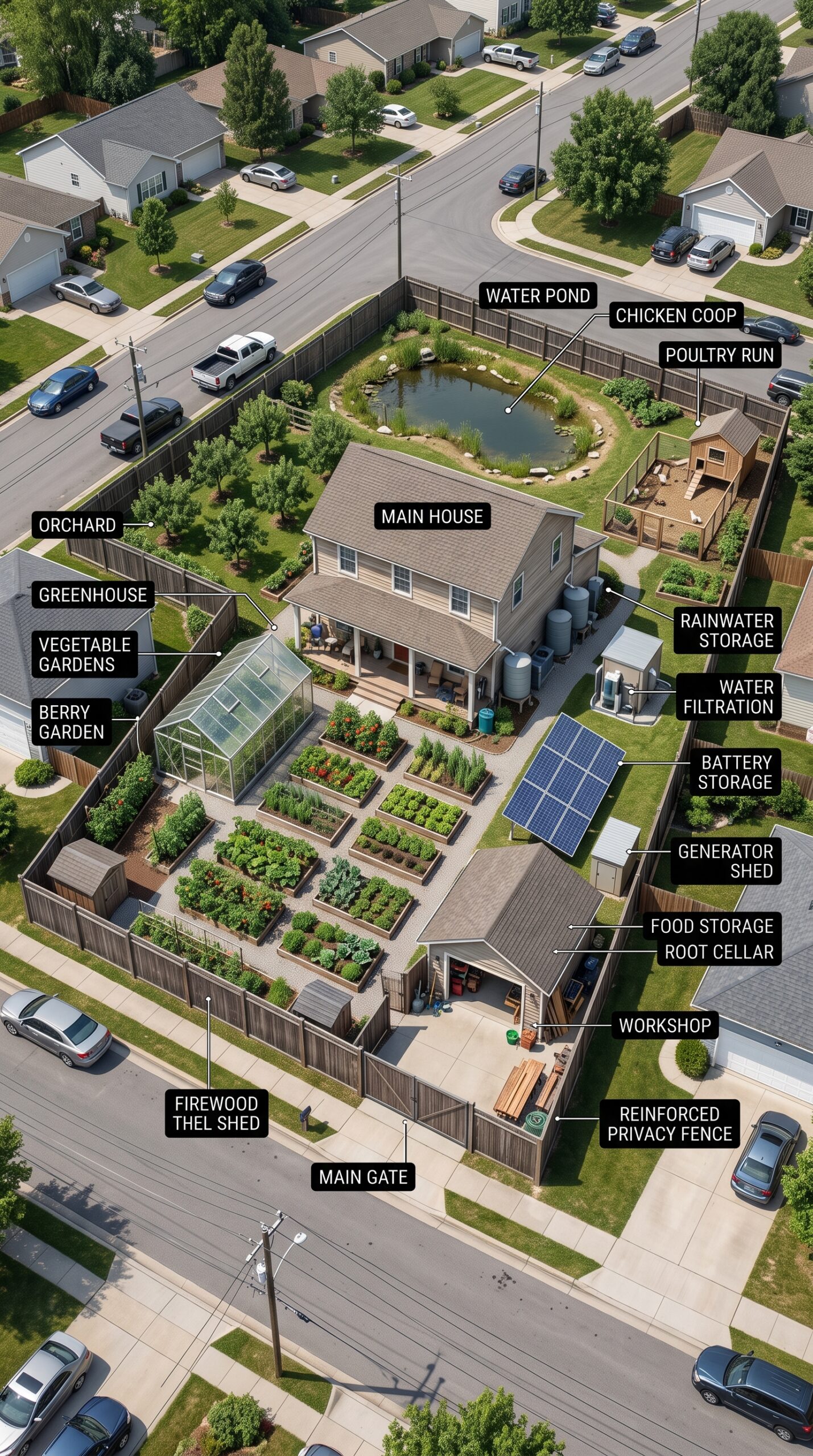
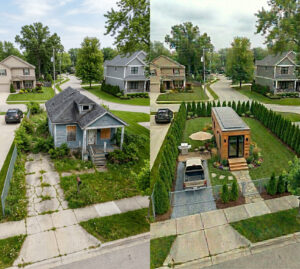
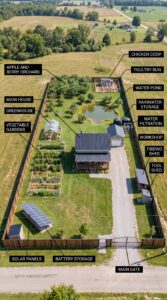
At first glance, the property looks like a typical American residential lot. It is surrounded by neighboring houses, paved streets, sidewalks and utility infrastructure. But inside the privacy fence, almost every available part of the property has been given a specific purpose. The backyard has become a productive agricultural area, the roof and ground-mounted panels provide renewable electricity, rainwater is collected in storage tanks, a dedicated filtration system manages water, and additional buildings provide space for workshops, food storage and equipment.
The most interesting part of the concept is its scale. This is not a giant ranch covering dozens of acres. It is a relatively compact suburban property where the owners have attempted to fit as much useful infrastructure as possible into the available land. The goal is not to become completely disconnected from the United States around them, but to reduce dependence on outside systems as much as realistically possible.
A Normal House With an Unusual Backyard
The main house remains the center of the property. It has the familiar appearance of a traditional American two-story suburban home, complete with a covered front porch and a conventional pitched roof. Inside, the house could remain completely comfortable, with bedrooms, bathrooms, a kitchen, living areas and normal household appliances.
The major difference is what happens outside.
Instead of using most of the backyard simply as ornamental lawn, the owners have divided it into productive zones. Vegetable beds occupy a large section of the property, while a greenhouse provides protected growing space. An orchard and berry garden add perennial crops, and a chicken coop provides a small-scale source of eggs.
The result is a property that still looks like a home but functions more like a miniature farm.
This approach could be particularly attractive to American homeowners who want greater independence but do not want to leave the suburbs. There are millions of residential properties across the United States with yards that are large enough to support some combination of gardens, fruit trees, rainwater systems and solar power.
The biggest challenge is not necessarily the amount of land. It is how intelligently that land is used.
The Vegetable Garden Becomes the Heart of Food Production
The largest productive area is dedicated to raised and organized vegetable beds.
Instead of one large field, the garden is divided into individual sections. This makes crop rotation, irrigation, harvesting and maintenance easier. Different beds could be dedicated to tomatoes, peppers, lettuce, carrots, onions, potatoes, beans, cucumbers, squash, herbs and other vegetables.
For a family, a well-managed suburban garden can provide a surprisingly large amount of fresh produce during the growing season.
It would not necessarily provide every calorie required by the household, and the owners would still purchase many staples from stores. But the garden could dramatically reduce the amount of fresh produce that needs to be purchased during spring and summer.
The garden also creates another important advantage: preservation.
A large harvest does not have to be consumed immediately. Tomatoes can be canned, vegetables can be pickled, herbs can be dried and suitable crops can be stored for winter. This turns the garden from a seasonal hobby into part of a larger food system.
The Greenhouse Extends the Growing Season
Next to the vegetable garden is a dedicated greenhouse.
In much of the United States, the growing season is limited by cold temperatures. A greenhouse allows the owners to start seedlings earlier and continue producing certain crops later into the year.
The structure shown here is large enough to support serious household gardening rather than simply serving as a decorative greenhouse.
Inside, it could contain raised beds, shelving, irrigation, ventilation and temperature monitoring. In colder climates, additional heating could be installed, although that would increase energy requirements.
The greenhouse also provides protection from heavy rain, wind and certain pests, giving the owners more control over the growing environment.
A realistic high-quality greenhouse of this scale could cost approximately $10,000–$25,000, depending on materials, foundation, glazing, ventilation and automation.
Orchard and Berry Garden
The property also includes an orchard and dedicated berry-growing areas.
Fruit trees are particularly useful on a long-term homestead because they continue producing once established. Apples, pears, plums, cherries and other varieties could be selected according to the regional climate.
Berry bushes can provide another productive layer without requiring enormous amounts of space. Raspberries, blackberries, blueberries, currants and similar crops can be incorporated into the landscaping.
Unlike annual vegetables, an orchard takes several years to reach meaningful production. That means planting trees is essentially an investment in the future.
A small suburban orchard might cost $3,000–$10,000 to establish, including trees, soil preparation, irrigation and protection.
Chickens Provide Eggs and More
The chicken coop is positioned toward the rear of the property, with an enclosed poultry run.
A small flock of hens could provide a regular supply of eggs for the household. The birds also produce manure that, when properly composted and managed, can become a useful source of nutrients for the garden.
The coop itself does not need to be enormous. Security, ventilation, shade, drainage and easy cleaning are more important than luxury construction.
The enclosed run also keeps the chickens from destroying the vegetable garden and allows the owners to manage where the birds can move.
A practical suburban chicken setup could cost around $3,000–$8,000, although local zoning and homeowner-association rules would need to be checked before construction.
The Backyard Pond
One of the most visually distinctive features is the small landscaped water pond.
The pond gives the property a natural appearance while potentially becoming part of its water-management system. Depending on how it is engineered and local regulations, it could collect runoff and provide water for landscaping or irrigation.
It should not automatically be considered a source of drinking water. Any water intended for household consumption requires appropriate treatment and testing.
The pond could also become a small ecosystem, with aquatic plants and surrounding vegetation providing habitat for insects, birds and other wildlife.
A professionally constructed pond of this size might cost approximately $8,000–$25,000, depending on excavation, soil conditions, drainage and landscaping.
Rainwater Storage
Several large tanks are positioned alongside the main house.
These tanks are designed to capture rainwater from roof runoff. Instead of allowing rainfall to immediately disappear into storm drains or the surrounding ground, the water can be collected and stored for later use.
For a suburban property, roof area is an important resource. A relatively large house can collect thousands of gallons of water during periods of significant rainfall.
The collected water could potentially be used for irrigation, gardening and other appropriate non-potable applications, subject to local regulations.
A complete residential rainwater system with gutters, filtration, pumps, storage tanks and controls could cost approximately $5,000–$20,000.
The real value is not just the stored water itself. It gives the property another layer of resilience during dry periods or disruptions to municipal water services.
Water Filtration
Next to the rainwater tanks is a dedicated water-filtration area.
A serious autonomous property cannot simply collect water and assume it is safe. Different water sources can contain completely different contaminants.
A well, rainwater tank and surface pond each require different approaches to treatment. A real system would therefore begin with laboratory testing and then be designed around the results.
Depending on the source, a system might include sediment filtration, carbon filtration, UV treatment, water softening or other treatment technologies.
A comprehensive residential water-treatment setup could cost roughly $5,000–$15,000, although more advanced systems can cost considerably more.
Solar Power
The property has a ground-mounted solar array positioned beside the garden.
This is one of the most important components of the autonomous design.
Solar panels generate electricity during daylight hours, reducing the property’s dependence on the utility grid. The system could power normal household loads such as refrigeration, lighting, electronics, pumps and appliances.
The exact size would depend on the house and its energy consumption. A suburban home using around 20–30 kWh per day might require a significantly different solar system from a property with electric heating, workshop equipment and high water-pumping demands.
For a system in the approximate 8–15 kW range, a realistic installed cost might be around $20,000–$45,000, depending on equipment, installation and local conditions.
The important point is that the solar array is not being treated as a decorative addition. It is part of a larger energy system.
Battery Storage
Solar generation alone does not create energy independence.
The sun is not shining at night, and cloudy weather can dramatically reduce production. That is why the property includes dedicated battery storage.
During sunny periods, excess electricity can be stored in batteries instead of immediately being used or sent back to the grid. At night, the stored energy can supply household loads.
A properly sized battery system can also provide backup power during grid outages.
For a suburban homestead, a battery installation of perhaps 20–40 kWh of usable storage could provide meaningful backup capacity, although the appropriate size would depend on which appliances the owners want to operate during an outage.
A system of this scale could cost approximately $20,000–$50,000 installed.
The combination of solar and batteries is what makes the property substantially more resilient than a normal house with rooftop panels alone.
Generator Backup
The property also includes a dedicated generator shed.
This may seem unnecessary when solar panels and batteries are already installed, but redundancy is one of the most important principles of resilient infrastructure.
During a long period of bad weather, solar generation can fall significantly. If batteries become depleted, a generator can provide another source of electricity.
The generator does not need to run constantly. Ideally, it would be reserved for situations where stored energy and solar generation are insufficient.
A permanently installed backup generator with appropriate electrical equipment could cost roughly $8,000–$20,000, depending on fuel type and capacity.
This creates three layers of electricity supply: solar generation, battery storage and generator backup.
Workshop and Garage
The property also includes a substantial workshop area.
For an autonomous homestead, a workshop can be more valuable than it initially appears.
Gardening equipment breaks. Pumps need maintenance. Fences need repairs. Tools need sharpening. Vehicles require servicing. Solar equipment occasionally needs attention. Lumber and building materials need somewhere to be stored.
Having a dedicated workshop allows the owners to perform many of these tasks on-site.
The workshop could include workbenches, shelving, power tools, gardening equipment, spare parts and general maintenance supplies.
A detached workshop/garage of approximately 500–800 square feet could cost around $40,000–$80,000, depending on construction quality and utilities.
Food Storage and Root Cellar
One of the most interesting additions is dedicated food storage.
Producing food is only half of the challenge. Storing it is equally important.
The property includes a dedicated building or storage area that could function as a pantry, root cellar and general food-storage room.
Potatoes, onions, carrots, squash and other crops can be stored for extended periods under appropriate conditions. Canned goods, grains and other shelf-stable supplies can occupy shelving.
This allows the household to build a reserve rather than depending on the grocery store every few days.
For a serious self-sufficiency project, food storage is one of the least glamorous but most valuable investments.
Firewood Storage
A dedicated firewood shed is positioned along the perimeter.
If the house has a wood-burning stove or fireplace, properly seasoned firewood can provide another heating option during winter power outages.
Even if the main heating system remains electric or gas, having an alternative source of heat provides additional resilience.
The shed itself could be relatively inexpensive, perhaps $2,000–$6,000, but the value comes from maintaining a dry, organized supply of fuel.
The Reinforced Privacy Fence
The entire property is surrounded by a substantial privacy fence.
Unlike a purely decorative suburban fence, this enclosure provides separation between the productive homestead and the surrounding neighborhood.
It also helps protect the garden, chickens, equipment and private outdoor areas.
The design shown here uses a heavier construction than a basic wooden privacy fence. For an actual suburban installation, however, the final height, materials and design would have to comply with local zoning regulations and neighborhood rules.
Depending on the property’s perimeter, a high-quality privacy fence with gates could cost approximately $20,000–$40,000.
The Biggest Challenge: Doing This in the Suburbs
The concept looks impressive, but suburban autonomy presents a completely different set of challenges from rural self-sufficiency.
The owners cannot simply build whatever they want.
Local zoning regulations may limit the number of chickens. Rainwater collection may be regulated differently from state to state. Solar installations can have setback requirements. Detached buildings may require permits. Fences have height restrictions. Some neighborhoods have homeowner associations with additional rules.
That means the first step would not be construction.
It would be research.
The owners would need to determine exactly what is legal on their property before spending money on infrastructure.
Fortunately, many of the technologies shown here are already common in American residential construction. Solar panels, battery systems, greenhouses, gardens, rain barrels, backup generators and workshops can all be incorporated into residential properties when properly planned and permitted.
How Autonomous Could This House Really Become?
The property would not literally become independent from civilization.
That is an important distinction.
The household would still likely use the internet, purchase fuel, buy replacement parts, occasionally purchase groceries and depend on outside services for healthcare, major repairs and specialized equipment.
The goal is instead to make the property resilient enough that a temporary disruption does not immediately become a crisis.
A grid outage would not necessarily mean sitting in darkness. Solar panels and batteries could maintain essential electricity.
A dry period would not immediately destroy the garden because stored water could supplement irrigation.
A disruption to grocery shopping would not immediately eliminate fresh vegetables because the property produces its own.
A winter power outage would have additional options through stored firewood and generator backup.
This is a much more realistic interpretation of home autonomy.
Estimated Cost of the Complete Transformation
The main house already exists, so the owners are not paying to construct an entirely new home. That makes this project considerably less expensive than building a completely autonomous homestead from scratch.
A realistic budget could look something like this:
Solar system: $20,000–$45,000 Battery storage: $20,000–$50,000 Generator and installation: $8,000–$20,000 Rainwater collection and storage: $5,000–$20,000 Water filtration: $5,000–$15,000 Greenhouse: $10,000–$25,000 Vegetable gardens and irrigation: $8,000–$20,000 Orchard and berry garden: $3,000–$10,000 Pond: $8,000–$25,000 Chicken coop and poultry run: $3,000–$8,000 Workshop/garage improvements: $40,000–$80,000 Food storage/root cellar: $10,000–$25,000 Firewood and tool storage: $5,000–$10,000 Privacy fencing and gates: $20,000–$40,000 Drainage, landscaping and site work: $15,000–$30,000
That puts the approximate investment for the transformation at around $180,000–$420,000, excluding the existing home and land.
For a realistic website headline, I would use a middle estimate of approximately $275,000 invested into the autonomy upgrade.
If the property itself is included in the valuation, the total value could easily reach $550,000–$850,000+, depending heavily on the American city, state, neighborhood and existing value of the house.
In an expensive metropolitan area, the underlying property could make the total value considerably higher.
What Makes This Concept Interesting
The most fascinating thing about this property is that it does not require a remote mountain location.
The owners are surrounded by ordinary American suburban homes.
There are cars parked on the street. Utility poles run along the roads. Neighboring houses are only a short distance away. Yet behind the privacy fence, the property has its own food production, water collection, energy generation, storage and backup systems.
It demonstrates that self-sufficiency does not have to mean disappearing into the wilderness.
A homeowner could begin with a vegetable garden, then add fruit trees. Solar panels could follow. Batteries could be installed later. A greenhouse could extend the growing season. Rainwater collection could reduce irrigation demand. Chickens could provide eggs. A workshop could improve the ability to maintain everything.
Each individual improvement may seem relatively small.
Together, they create a completely different type of home.
The Modern American Autonomous Home
Traditional American homes were generally designed around convenience: electricity comes from the grid, water comes through municipal pipes, food comes from supermarkets and waste disappears through established infrastructure.
This property takes the opposite approach.
Instead of relying on a single system for every essential need, it creates layers of redundancy.
Electricity comes from solar, is stored in batteries and can be supplemented by a generator. Water can be collected, stored and treated. Food can come from gardens, the greenhouse, orchard and chickens, while preserved supplies provide another reserve. A workshop provides the tools and space required to maintain the property.
The house itself remains completely normal and comfortable.
That may ultimately be the most appealing part of the concept.
You do not need to abandon modern life to become more self-sufficient. You can simply redesign the property you already have.
Estimated autonomy upgrade: approximately $275,000. Estimated total property value including an existing suburban home: roughly $550,000–$850,000+, depending on location.
For a homeowner willing to make a serious investment, this could turn an ordinary American backyard into something far more valuable than a lawn: a private, productive and resilient homestead designed to keep working when the systems around it don’t.
This project is a conceptual design created for inspiration and architectural visualization. It is not a real construction project or a technical blueprint.


Leave a Reply