How Much Would It Cost to Build This Self-Sufficient Homestead in Rural America?
At first glance, this property looks like a beautiful country home surrounded by farmland. But look closer, and it becomes clear that it is much more than a house.
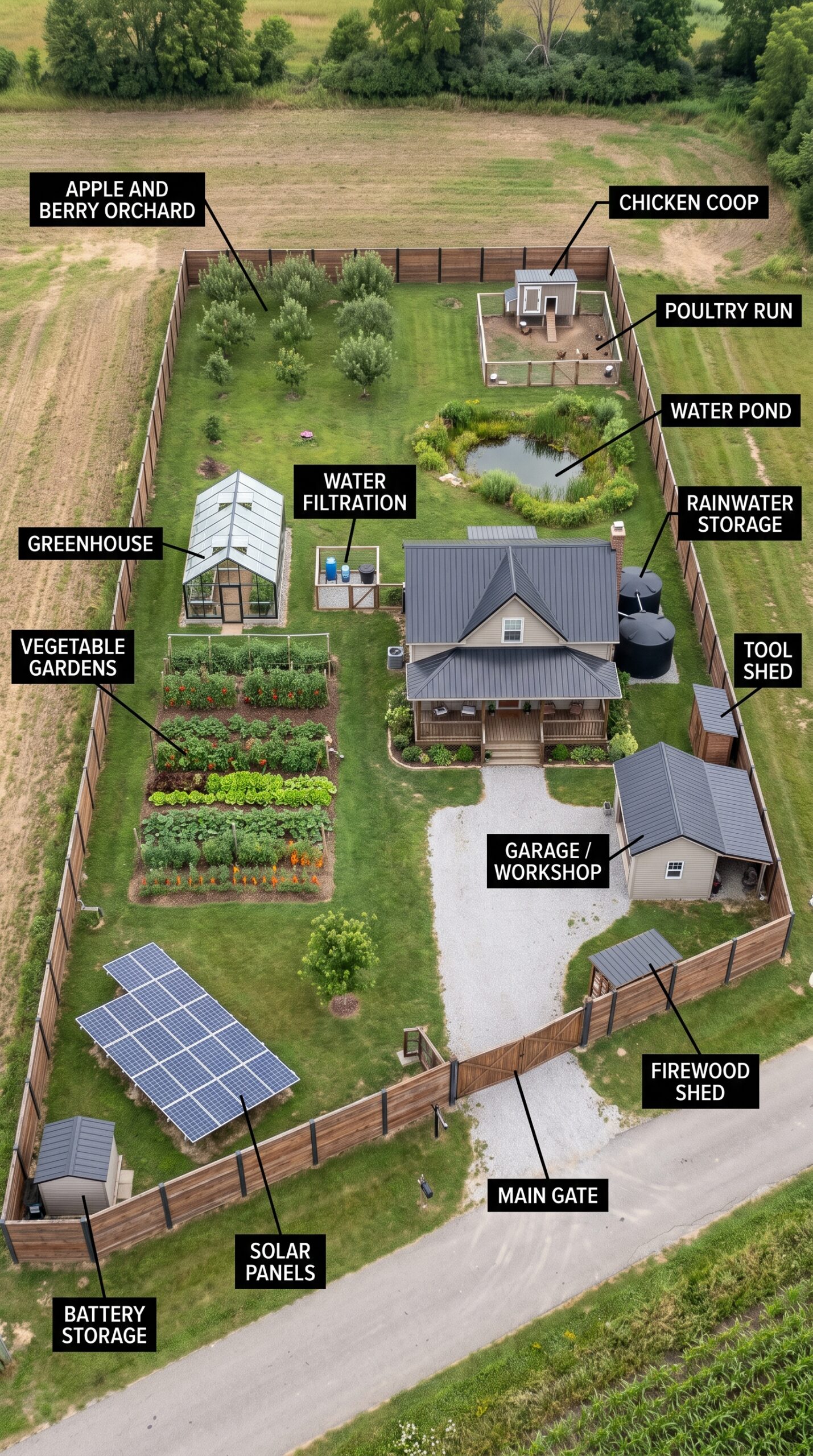
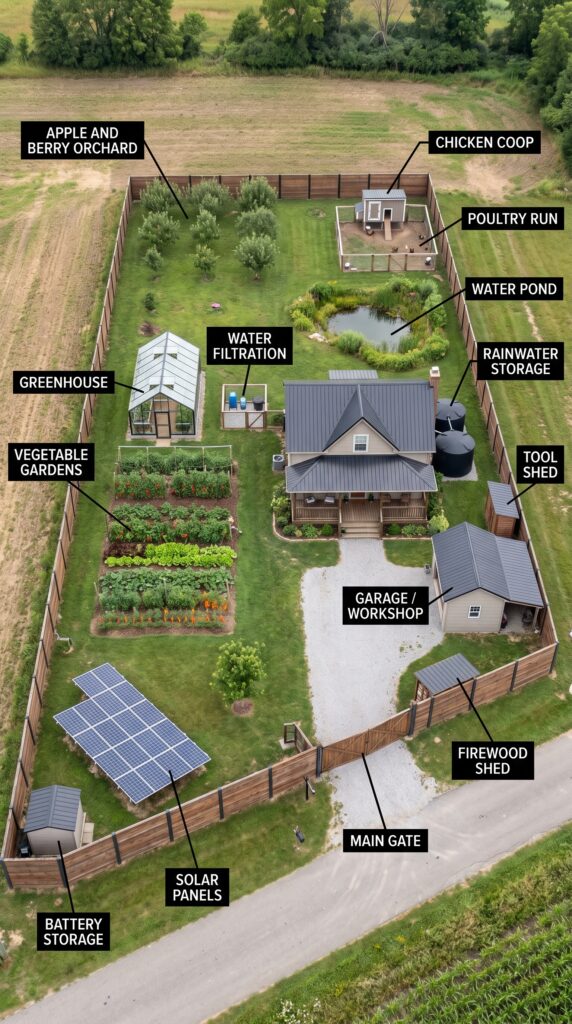
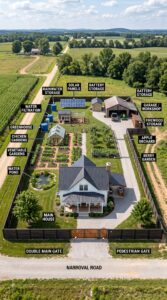
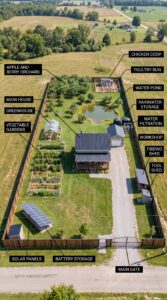
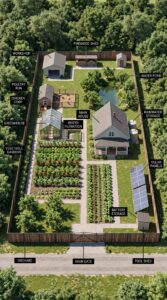
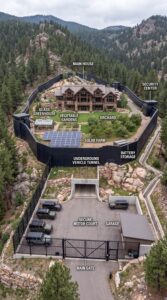
This is a complete rural homestead designed around food production, water independence, renewable energy, storage, security, and everyday comfort. The property has a main house, greenhouse, vegetable gardens, an apple and berry orchard, chicken coop, poultry run, water pond, rainwater storage, water filtration, solar panels, battery storage, a garage and workshop, a firewood shed, a tool shed, and a secure perimeter fence with a main vehicle gate.
It represents a very different idea of the American dream: instead of living on a small suburban lot and depending almost entirely on outside infrastructure, the homeowner has enough land and infrastructure to produce a meaningful portion of the family’s food, water, and energy.
But how much would it actually cost to build something like this in the United States?
The answer depends heavily on location, land prices, construction costs, local regulations, and the quality of the systems installed. A modest version could potentially be built for several hundred thousand dollars, while a high-end version in an expensive state could easily approach or exceed $1 million.
Here is how the property could be developed.
The Main House
The center of the property is the main house.
The design shown here is intentionally practical. It has the appearance of a traditional American farmhouse, but with modern construction, a durable metal roof, a large covered porch, comfortable living spaces, and enough room for a family.
A house of approximately 2,000–2,500 square feet could provide several bedrooms, bathrooms, a kitchen, living room, storage areas, and mechanical space without becoming unnecessarily large.
In many rural parts of the United States, a quality custom or semi-custom house of this size could potentially fall somewhere around $250,000–$500,000, although construction prices vary dramatically between states and even between neighboring counties.
The price could be significantly higher if the homeowner chooses luxury finishes, complicated architecture, large amounts of glass, premium appliances, or expensive mechanical systems.
For this type of property, however, spending money on the structure itself is only one part of the equation.
A well-insulated building envelope, efficient windows, durable roofing, efficient heating and cooling, and carefully designed electrical and plumbing systems can be much more valuable over decades than purely decorative upgrades.
The covered porch also provides a useful transition between the house and the landscape, creating a comfortable outdoor space where the family can sit, eat, or simply enjoy the property.
A Secure Perimeter
The entire property is enclosed by a substantial wooden privacy fence.
This is one of the first things that separates the homestead from an ordinary rural house.
The fence establishes a clear boundary and provides privacy from neighboring properties and passing vehicles. It also helps contain pets and livestock while creating a controlled entrance to the property.
The main gate is positioned directly beside the driveway, allowing vehicles to enter the property while keeping the rest of the perimeter closed.
A high-quality perimeter fence around several acres can become a significant expense. Depending on the total length, materials, terrain, posts, concrete footings, gates, and labor, the cost could easily reach $20,000–$60,000 or more.
An automated gate, security cameras, exterior lighting, keypad access, and an intercom system could add several thousand dollars.
The important thing is that the fence should be treated as part of the overall property infrastructure rather than simply as decoration.
The Solar Power System
One of the most important features is the ground-mounted solar array.
The panels are positioned in an open section of the property where they can receive strong sunlight without being shaded by the house or mature trees.
A system of this type could potentially be designed around 10–20+ kW of solar capacity, depending on the family’s electricity consumption.
The energy produced during the day could supply the home and other buildings while charging a battery bank.
Battery storage is particularly valuable because solar production naturally falls at night and during periods of bad weather.
A complete residential solar and battery system could cost roughly $40,000–$100,000+, depending on the capacity, equipment, installation, electrical upgrades, and local conditions.
For a property like this, the system would ideally be connected to a properly designed backup strategy.
The goal would not necessarily be to disconnect from the electrical grid completely.
Instead, the homeowner could remain grid-connected while using solar and batteries to reduce electricity purchases and provide backup power when the grid experiences an outage.
That approach can be considerably more practical than attempting to make every appliance and system completely independent.
Battery Storage
The solar panels are only half of the energy system.
Nearby battery storage allows electricity generated during the day to remain available after sunset.
A battery system could power essential household loads such as refrigerators, lighting, communications equipment, water pumps, heating controls, and other critical equipment during an outage.
The size of the battery bank would depend on how much electricity the family normally consumes and which systems need to remain operational.
A smaller system might provide several hours of backup, while a larger installation could potentially support essential loads for a day or longer depending on consumption and weather.
The battery enclosure would also need to comply with applicable electrical, fire, and building requirements.
Rainwater Storage
Two large tanks beside the house are used for rainwater storage.
The basic concept is simple: rain falling on the roof is collected through gutters and directed into storage tanks instead of immediately flowing away.
The stored water could potentially be used for irrigation, landscaping, and other appropriate purposes, subject to local regulations.
Rainwater collection is particularly useful on a homestead because gardens can consume enormous amounts of water during the growing season.
Instead of using treated municipal water for every garden bed, stored rainwater can provide an additional resource.
A complete system with tanks, gutters, pumps, filters, piping, and installation could potentially cost $5,000–$20,000+, depending on capacity and complexity.
The homeowner would need to check state and local rules before designing the system, especially if the water is intended for household consumption.
Water Filtration
The property also contains a dedicated water filtration area.
This is important because having a well or rainwater system does not automatically guarantee safe drinking water.
A rural home may require sediment filtration, carbon filtration, water softening, iron removal, UV treatment, or other processes depending on the local water source.
The correct equipment should be selected after testing the water.
A basic whole-house filtration system might cost several thousand dollars, while a more advanced system could cost substantially more.
For a resilient homestead, it would also make sense to maintain replacement filters, pumps, valves, fittings, and other critical components on-site.
The purpose is simple: if something fails, the family should not necessarily have to wait several days for a specialized part to arrive.
The Greenhouse
Next to the vegetable gardens is a permanent greenhouse.
This structure provides a controlled environment for starting seedlings and extending the growing season.
In colder parts of the United States, a greenhouse can be especially valuable because it allows the homeowner to begin planting before outdoor conditions are suitable.
Inside, the family could grow tomatoes, peppers, cucumbers, herbs, lettuce, seedlings, and many other crops.
A greenhouse of this size, with a durable frame, glazing, ventilation, irrigation, benches, and basic environmental controls, could cost approximately $8,000–$30,000.
A simple DIY greenhouse could be considerably cheaper, while a commercial-grade structure with heating and automated controls could cost much more.
The greenhouse also provides insurance against unpredictable weather.
Heavy rain, strong winds, late frosts, and short growing seasons can all reduce garden production. A protected growing area gives the homeowner another way to maintain food production.
The Vegetable Gardens
The largest agricultural area on the property is dedicated to vegetables.
Instead of growing everything in one large field, the garden is divided into organized rows and beds.
This makes crop rotation easier and allows different plants to be managed independently.
A garden of this size could produce substantial quantities of vegetables during the growing season.
Possible crops could include:
Tomatoes
Potatoes
Carrots
Onions
Garlic
Lettuce
Cabbage
Beans
Peas
Cucumbers
Peppers
Squash
Broccoli
Herbs
Various root vegetables
The garden could also incorporate drip irrigation, composting, mulch, trellises, and protective netting.
The initial investment might be around $5,000–$20,000, depending on how much fencing, irrigation, soil improvement, raised beds, and infrastructure is installed.
The bigger investment is time.
A garden this productive requires regular maintenance. Planting is only the beginning. The homeowner must water, weed, prune, fertilize, monitor pests, harvest, and preserve the food.
That means the property is not maintenance-free.
It is designed to turn time and land into useful resources.
Apple and Berry Orchard
At the rear of the property is an apple and berry orchard.
Fruit trees require patience because they take several years to become productive, but once established they can provide food for many seasons.
Apple trees are particularly useful because properly stored apples can remain available well beyond harvest season.
The orchard could also include pears, plums, cherries, peaches, blueberries, raspberries, blackberries, and other crops suited to the local climate.
A small orchard might cost only a few thousand dollars to establish, but irrigation, soil preparation, tree protection, fencing, mulch, and maintenance can increase the cost.
One advantage of an orchard is that it becomes more productive as it matures.
Unlike an annual vegetable garden, which must be replanted every year, established fruit trees can continue producing for decades with appropriate care.
Chicken Coop and Poultry Run
The property includes a dedicated chicken coop and enclosed poultry run.
Chickens are one of the most practical forms of small-scale livestock for a family homestead.
They require relatively little space and can provide eggs on a regular basis.
The poultry run gives the birds access to outdoor space while keeping them contained.
The coop should provide protection from weather and predators, nesting boxes, roosting areas, ventilation, and easy access for cleaning.
A well-built coop and run could cost approximately $3,000–$10,000, depending on size and materials.
The surrounding enclosure is particularly important in rural areas where predators can include foxes, raccoons, coyotes, hawks, and other wildlife.
Feed should also be stored in sealed containers to prevent rodents from turning the chicken area into a food source.
The Water Pond
A small pond is located near the orchard and chicken area.
A pond can serve several purposes on a rural property.
It can improve the landscape, provide wildlife habitat, support certain irrigation uses where legally appropriate, and act as an additional water reserve.
However, building a pond requires considerably more planning than simply bringing in an excavator.
The site needs suitable soil, appropriate drainage, and enough water to maintain the pond.
Local environmental regulations may also apply.
A small agricultural or recreational pond could cost approximately $10,000–$50,000+, depending on excavation, soil conditions, access for heavy machinery, landscaping, and engineering requirements.
A natural-looking pond with vegetation around the edges could also become one of the most attractive features of the property.
The Garage and Workshop
Near the main house is a detached garage and workshop.
This building is extremely useful for a property like this.
A normal suburban garage might primarily store cars.
Here, the building becomes a maintenance center for the entire homestead.
It could contain vehicles, lawn equipment, tractors, generators, woodworking tools, mechanical equipment, spare parts, building materials, and gardening equipment.
The workshop could also provide a place to repair irrigation systems, build raised beds, fix fencing, maintain agricultural machinery, and perform general household repairs.
A detached structure of approximately 800–1,500 square feet could cost somewhere around $60,000–$150,000+, depending on construction, foundation, insulation, electrical service, doors, interior finishes, and local labor costs.
For a serious homestead, this may be one of the best places to spend money.
The ability to repair things yourself can save considerable money over the life of the property.
Firewood Storage
A dedicated firewood shed stands near the workshop.
This is a simple structure, but it can be extremely useful in areas where wood heating is common.
Keeping firewood elevated and protected from precipitation helps it dry properly.
The amount of firewood required depends on the home’s heating system and climate.
A basic woodshed could cost only a few thousand dollars, especially if built by the homeowner.
The important thing is to keep the wood dry, ventilated, and organized.
Tool Shed
A separate tool shed provides another layer of organization.
Rather than storing shovels, hoses, wheelbarrows, pruning tools, lawn equipment, and gardening supplies inside the workshop or house, they can remain close to the areas where they are used.
A small shed could cost approximately $2,000–$8,000.
This may seem insignificant compared with the house and solar system, but small storage structures make a large property much easier to manage.
The Driveway and Landscaping
Another major expense is everything that connects the buildings.
The driveway shown here is gravel, which is common in rural America and usually costs considerably less than a fully paved road.
However, a proper gravel driveway still requires grading, drainage, a suitable base, compacted aggregate, and periodic maintenance.
The property also needs walking paths between the house, gardens, greenhouse, workshop, chicken coop, and other structures.
Drainage is particularly important.
A beautiful homestead can become extremely difficult to use if heavy rain turns the driveway and garden paths into mud.
Depending on the property, site preparation and landscaping could easily add $20,000–$75,000+ to the project.
How Much Land Would You Need?
The exact acreage depends on the design.
A compact version of this homestead could potentially fit on 2–3 acres if the buildings and agricultural areas were carefully arranged.
A more comfortable version might use 5–10 acres, giving the family more room for expansion, additional orchards, larger gardens, livestock, recreation, and future buildings.
The image shows a property surrounded by agricultural land, which is exactly the type of setting where this concept would make the most sense.
The key is not simply finding a large parcel.
The land needs to be usable.
A 10-acre property covered by steep slopes, wetlands, dense forest, or flood-prone ground may be less useful than a well-drained five-acre parcel with good soil and road access.
The Land Could Be the Wild Card
Land prices are perhaps the hardest part of the budget to predict.
In some rural parts of the Midwest or South, several acres can still be relatively affordable.
In desirable areas close to major cities, mountain communities, or popular recreational regions, the same amount of land could cost several times more.
For this reason, a hypothetical budget might allocate $50,000–$250,000+ for the land.
In particularly expensive markets, the land alone could exceed the entire construction budget of the homestead.
This is why choosing the location is arguably the most important financial decision in the entire project.
A Possible Budget
A realistic mid-range version of this property could look something like this:
Land: $75,000–$250,000 Main house: $300,000–$500,000 Perimeter fence and gates: $25,000–$60,000 Solar system: $25,000–$60,000 Battery storage: $15,000–$40,000 Well and water infrastructure: $10,000–$30,000 Rainwater storage: $5,000–$20,000 Water filtration: $3,000–$10,000 Greenhouse: $8,000–$25,000 Vegetable gardens: $5,000–$15,000 Orchard: $3,000–$10,000 Chicken coop and poultry run: $3,000–$8,000 Pond: $10,000–$40,000 Garage/workshop: $60,000–$150,000 Firewood and tool sheds: $5,000–$12,000 Driveways, drainage and landscaping: $25,000–$75,000
That produces a broad potential range of approximately $577,000 to $1.3 million or more.
For a well-designed property in a moderately priced rural area, a reasonable target could be somewhere around $700,000–$900,000, including land and major infrastructure.
Of course, this is a conceptual estimate rather than a contractor’s quote. Actual costs would need to be determined by local builders, engineers, well contractors, electricians, and other professionals.
Is This Property Truly Off-Grid?
Not necessarily.
And that is actually one of the most interesting aspects of the design.
There is a major difference between being completely off-grid and being highly resilient.
A completely off-grid property might eliminate the electrical grid, municipal water, natural gas, and other public infrastructure entirely.
But that can introduce additional complexity and expense.
A hybrid approach can often be more practical.
The property can remain connected to the electrical grid while using solar panels and batteries to reduce dependence on it.
The house can use a private well while rainwater is collected for irrigation.
The garden can provide vegetables while the family continues buying food from stores.
The chickens can provide eggs while commercial feed is still purchased.
In other words, the property does not need to produce absolutely everything.
It simply needs to produce enough that the family has alternatives.
What Makes a Homestead Like This Valuable?
The greatest advantage is not any individual component.
It is the combination.
Solar panels alone provide electricity.
A greenhouse alone provides a longer growing season.
A well alone provides water.
A garden alone provides vegetables.
A workshop alone provides a place to repair equipment.
But when all of these systems are combined, they create something much more powerful.
The property becomes a network of interconnected resources.
Rainwater can support the gardens.
Garden waste can become compost.
Compost improves the soil.
The orchard produces fruit.
The chickens provide eggs and manure.
Solar energy powers pumps and household systems.
The workshop maintains the equipment.
The garage stores vehicles and machinery.
The fence protects the property and livestock.
The house provides a comfortable base for everything.
This is what makes the design more than simply a country house.
It is a small private infrastructure system.
The Hidden Cost: Time
There is one cost that cannot easily be calculated in dollars.
Time.
A property like this requires maintenance.
The grass must be cut.
Trees must be pruned.
Vegetables must be planted.
Greenhouse plants must be monitored.
Chicken coops must be cleaned.
Fences need inspection.
Solar panels may need occasional cleaning and maintenance.
Water filters need replacement.
The pond needs management.
The workshop needs organization.
Firewood needs to be cut, split, stacked, and dried.
And the house itself still requires all of the normal maintenance of any American home.
This is not a property where the owner can simply arrive on Friday evening and forget about everything until Monday morning.
It is a lifestyle.
For someone who enjoys gardening, building, repairing, and spending time outdoors, that can be a benefit rather than a disadvantage.
Could It Produce Most of the Family’s Food?
With enough land and experience, a property like this could produce a surprisingly large percentage of a family’s fresh food.
Vegetables could provide much of the summer produce.
An orchard could supply fruit.
Berry bushes could extend the harvest season.
Chickens could provide eggs.
A greenhouse could extend production into spring and fall.
The family could also preserve food through freezing, drying, fermentation, and canning where appropriate.
But complete food independence would be much more difficult.
Staples such as flour, cooking oil, salt, sugar, coffee, spices, animal feed, and many other products would still normally come from outside.
Producing calories at scale requires considerably more land and labor than producing vegetables.
So the realistic objective is not necessarily to eliminate grocery shopping.
It is to reduce dependence and create a reliable supplemental food system.
Could It Survive a Long Power Outage?
This is where the combination of systems becomes particularly valuable.
During a grid outage, solar panels can continue producing electricity during daylight hours, while batteries provide energy after sunset.
The well can continue operating if the pumps are connected to the backup electrical system.
The refrigerator and freezer can remain operational.
Water filtration can continue.
Essential lighting and communications can remain available.
The workshop can potentially provide the ability to make repairs.
The garden and orchard continue producing food regardless of the electrical grid.
A backup generator could provide another layer of redundancy during extended periods of cloudy weather.
None of this makes the property invulnerable.
But it can make a temporary disruption significantly easier to manage.
The American Homestead Reimagined
This property represents a modern version of an old American idea.
For generations, rural families depended on their land for at least part of their food, heating, water, and income.
Modern technology changed that relationship.
Today, most people can simply turn on a faucet, plug something into an outlet, or drive to a supermarket.
But the modern homestead combines the convenience of today’s technology with some of the independence of traditional rural living.
Solar panels replace part of the dependence on the electrical grid.
A greenhouse extends the growing season.
A vegetable garden replaces part of the dependence on supermarkets.
An orchard creates a long-term source of fruit.
A chicken coop provides eggs.
Rainwater storage provides another water source.
A workshop provides the ability to maintain the property.
And the secure perimeter gives the family privacy and control over the land.
It is not about going backward.
It is about combining old and new ideas.
Would You Spend $800,000 on This?
If you had the choice between spending roughly $800,000 on a conventional house in a desirable American suburb or building something like this on several acres of rural land, which would you choose?
The conventional house might give you shorter commutes, nearby restaurants, schools, shopping, and easier access to services.
This property gives you something completely different.
You get land.
You get privacy.
You get gardens.
You get an orchard.
You get renewable energy.
You get water storage.
You get a workshop.
You get livestock infrastructure.
And most importantly, you get the ability to gradually make the property more independent over time.
It would require more work and responsibility than an ordinary home.
But for someone who wants space, privacy, food production, and resilience, that extra work could be exactly the point.
Would you build a self-sufficient homestead like this if you had $800,000 to invest — or would you rather spend the money on a conventional American home?
This project is a conceptual design created for inspiration and architectural visualization. It is not a real construction project or a technical blueprint.

Leave a Reply