How Much Would It Cost to Build This Self-Sufficient Homestead in Rural America?
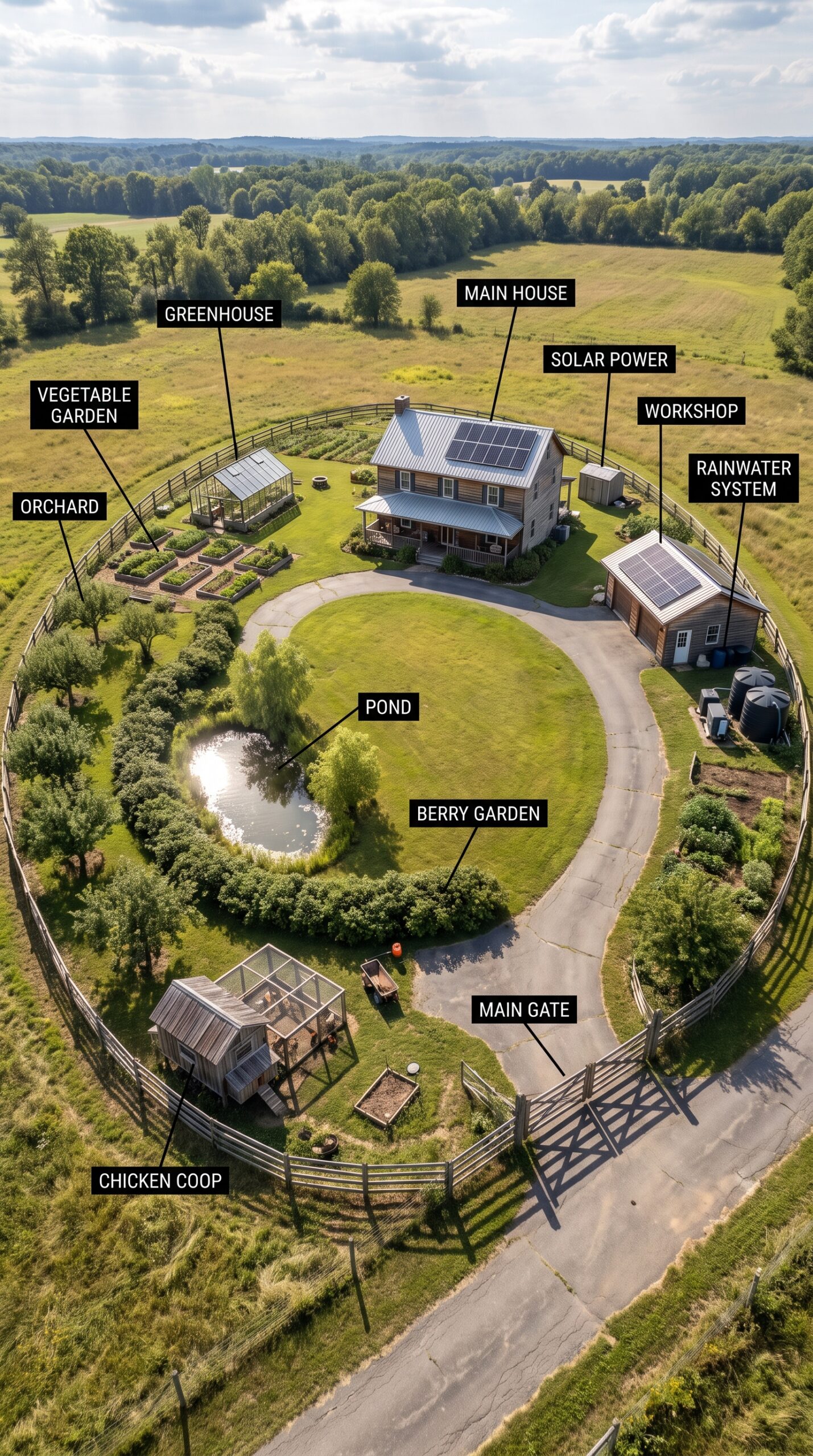
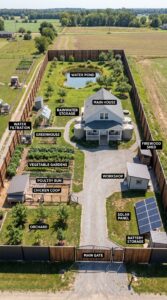
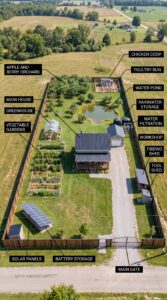
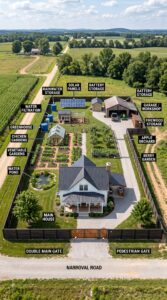
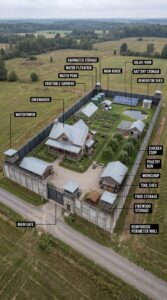
Imagine owning a private piece of countryside where your entire property is designed around one simple goal: living comfortably while producing as much of your own food, water and energy as possible. Instead of having a house surrounded by an empty lawn, this homestead combines a main residence, greenhouse, vegetable garden, orchard, berry garden, chicken coop, pond, workshop, solar power and rainwater collection into one carefully planned property. The concept shown here represents the kind of rural American homestead that could provide a family with privacy, space and a greater degree of independence without completely disconnecting from modern life. It looks peaceful and simple from above, but building something like this in the United States would involve a surprisingly large investment. The final price would depend heavily on the state, county, land prices, building costs, terrain, utility connections and how much of the work the owner is willing to complete personally.
Starting With the Land
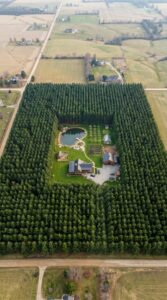
The first step would be finding the right piece of property. A homestead like this does not necessarily require hundreds of acres. A carefully designed property could fit comfortably on several acres, while a larger parcel would provide additional forest, pasture and privacy. The ideal location would have a relatively open area for the buildings and gardens, with mature trees around the perimeter. Access to a public road is also extremely important because construction equipment, deliveries, vehicles and emergency services all need reliable access. A rural property with an existing driveway, well, septic system and electrical connection could save a new owner a substantial amount of money, while completely undeveloped land may initially look cheaper but require significant investment before construction can even begin. Depending on the region, rural acreage might cost $50,000, $100,000, $250,000 or considerably more. In desirable areas near major cities, mountains, lakes or popular recreational destinations, the land alone could cost several hundred thousand dollars.
The Main House
At the center of the property is the main house. The design shown in the image is a practical rural home rather than an enormous luxury mansion. A house of approximately 1,800 to 2,500 square feet could provide enough space for a family while keeping construction and maintenance costs under control. The house could include three or four bedrooms, two or three bathrooms, a large kitchen, living room, pantry, laundry room and a covered front porch. The positioning is important because the house should have easy access to the gardens, workshop and utility systems without sacrificing privacy or views. Large windows could face the pond and surrounding landscape, while the kitchen could be positioned close to the vegetable garden so that freshly harvested food is only a few steps away. In many parts of the United States, a professionally constructed rural home of this size could easily cost $300,000–$500,000 depending on the local labor market, foundation requirements, materials, interior finishes and architectural complexity. A simpler owner-built design could potentially cost less, while a custom high-end house could push far beyond this range.
The Vegetable Garden
One of the most valuable parts of the property would not be the house at all, but the vegetable garden. The garden shown in the concept is large enough to provide a meaningful amount of fresh produce for a family. Instead of planting one enormous field, the space is divided into organized beds with walking paths between them. This makes planting, watering, harvesting and crop rotation much easier. Depending on the climate, the garden could contain tomatoes, potatoes, onions, carrots, lettuce, cabbage, peppers, beans, cucumbers, squash, peas, herbs and many other crops. Raised beds could be used where soil quality is poor, while traditional in-ground beds could reduce construction costs. Drip irrigation could deliver water directly to the plants and reduce waste. Compost produced from garden waste, leaves and chicken manure could gradually improve the soil. A serious garden of this size might require $5,000–$15,000 for initial preparation, fencing, irrigation, soil amendments, beds, tools and planting materials. Once established, however, annual costs could be much lower because seeds can be saved and compost can be produced on the property.
The Greenhouse
Next to the garden is a greenhouse designed to extend the growing season. This becomes especially valuable in regions where spring arrives late or winter arrives early. Seedlings can be started inside the greenhouse before they are moved outdoors, while tomatoes, peppers, herbs and other crops can remain protected for much longer than they could in an open garden. A simple greenhouse could cost only a few thousand dollars, while a larger structure with automatic ventilation, irrigation, heating and climate controls could cost $15,000–$30,000 or more. For a property like this, a budget of approximately $10,000–$20,000 would create a useful growing structure without turning it into an expensive commercial greenhouse.
The Orchard and Berry Garden
The orchard gives the property another source of food while also making the landscape more attractive. Apple trees could form the main orchard, with pears, peaches, plums or other fruit trees added depending on the local climate. Around the perimeter of the garden, berry bushes could provide raspberries, blackberries, blueberries and other perennial crops. Unlike annual vegetables, fruit trees require patience. Young trees may take several years before producing substantial harvests, but once mature they can provide food for decades with proper care. A small orchard and berry garden might require $5,000–$12,000 to establish, including trees, bushes, soil preparation, irrigation, mulch and protection from wildlife. The real advantage is that the orchard becomes more productive over time rather than requiring a complete restart every spring.
Chickens and the Poultry Yard
The chicken coop shown near the entrance would provide another useful source of food. A secure coop combined with an outdoor poultry run gives chickens room to move while protecting them from predators. Depending on local regulations and the family’s needs, a flock could provide fresh eggs throughout much of the year. Chickens also produce manure that can eventually become valuable compost for the garden when properly managed. A practical coop and fenced run might cost $3,000–$8,000 depending on size, materials, automatic doors, fencing and predator protection. The system could be designed so that feeding and cleaning are simple enough to become part of the family’s normal daily routine.
The Pond
The small pond in the center of the property is one of the most attractive features of the design. It creates a natural focal point and can provide habitat for wildlife while adding a completely different atmosphere to the homestead. Depending on local regulations and site conditions, a pond could potentially be used for irrigation or other non-potable purposes, although water use and construction requirements vary by location. The cost can also vary dramatically. A small landscaped pond might cost around $10,000–$20,000, while a professionally engineered pond requiring extensive excavation, grading, drainage and lining could cost $30,000 or more. Before construction, the property would need to be evaluated for soil conditions, drainage, groundwater and potential flood issues.
Rainwater Collection
The buildings themselves can become part of the water system. Rain falling on the roofs can be captured through gutters and directed into storage tanks. Instead of allowing thousands of gallons of rainwater to disappear into the ground, the system can store it for later use. Depending on local regulations, collected rainwater can potentially be used for irrigation and other non-potable purposes. A more advanced system could include filtration and treatment, but drinking water should always be treated according to local requirements and tested for safety. A residential rainwater collection system with multiple tanks, pumps, gutters and filtration could cost approximately $5,000–$15,000. The amount of storage required would depend on the roof area, local rainfall patterns and the property’s water demand.
Well and Water Filtration
If the property is outside a municipal water system, a private well could provide the primary household water supply. This is one of the systems that should be investigated before buying the land. The presence of groundwater does not automatically guarantee that drilling a well will be easy or inexpensive. Depth varies from one region to another, and water quality can also vary significantly. A complete system could include the well, pump, pressure tank, filtration equipment and treatment equipment where necessary. A reasonable preliminary allowance might be $10,000–$25,000, although difficult drilling conditions could increase the cost. Water should be tested before designing the filtration system because different sources may require completely different treatment.
Solar Power
The solar panels are another important component of the property. A roof-mounted or ground-mounted solar array could reduce dependence on the electrical grid, while battery storage could provide electricity when the sun is not producing power. The system could supply the house, workshop, water pumps, greenhouse equipment and other essential loads. The exact size would need to be calculated from the family’s actual electricity consumption. A property designed for partial energy independence might use a smaller system, while a genuinely off-grid home with electric appliances, pumps and workshop equipment could require a much larger installation. A serious residential solar and battery system could easily cost tens of thousands of dollars, and a larger off-grid installation could reach $60,000–$100,000 or more. The biggest mistake would be choosing the system based only on the number of panels. Battery capacity, inverter size, winter solar production and peak electrical demand are equally important.
Garage and Workshop
The detached workshop shown on the right side of the property would be extremely useful. A homestead requires constant maintenance, and having a dedicated building for tools, vehicles, lawn equipment, woodworking, repairs and agricultural equipment keeps those activities away from the main house. A garage/workshop of approximately 600–1,000 square feet might cost $40,000–$100,000 depending on the foundation, framing, insulation, doors, electrical system and interior finish. The building could initially be left relatively simple and upgraded over time. A strong workbench, storage shelving, compressor, basic power tools and equipment would gradually transform it into the practical center of the property.
Firewood and Tool Storage
Small storage structures might seem insignificant compared with the house, but they make a major difference in everyday life. A covered firewood shelter would protect several cords of wood from rain and snow, while a separate tool shed could store gardening equipment, hoses, hand tools and seasonal items. Combined, these structures might cost approximately $5,000–$15,000 depending on their size and construction. If the property is located in a colder region where wood heating is used regularly, the firewood storage area could be considerably larger.
Fencing and Security
The perimeter fence gives the entire property a defined boundary. It helps keep chickens and pets inside, discourages wildlife from entering the gardens and provides privacy from surrounding roads and properties. The cost of fencing several acres can become surprisingly high. Materials, terrain, gates and labor all influence the final number. A basic agricultural fence could be relatively inexpensive, while the heavy wooden privacy-style fencing shown in the concept could easily cost tens of thousands of dollars. A realistic allowance for a substantial perimeter fence and main gate might be $25,000–$70,000 or more. The main entrance should also be wide enough for construction trucks, tractors and emergency vehicles.
Driveway and Site Preparation
Before the house and gardens can be built, the land itself needs to be prepared. This could include clearing selected trees, grading, drainage, excavation, driveway construction and utility trenches. A gravel driveway may be perfectly suitable for a rural property and considerably cheaper than asphalt. If the terrain is relatively flat, site preparation might remain manageable, but steep slopes, poor soil or difficult drainage could increase the cost dramatically. A preliminary budget of $25,000–$75,000 for access roads, grading and basic site preparation would be reasonable for planning purposes.
Septic and Wastewater
A rural property without municipal sewer would also require its own wastewater system. This is another reason why the land should be carefully evaluated before purchase. Septic systems depend on soil conditions and local regulations, and not every parcel can accommodate the same type of system. A conventional septic system might cost several thousand dollars, while engineered systems for difficult soils can cost considerably more. A reasonable planning range could be $7,000–$30,000. The exact design should come from a qualified local professional after the property has been evaluated.
How Much Would the Entire Homestead Cost?
When all of these components are combined, this stops being an ordinary house project and becomes a complete rural infrastructure project. For a realistic version in the United States, the approximate budget could look like this: rural land $100,000–$250,000; main house $300,000–$500,000; garage/workshop $50,000–$100,000; solar and battery system $50,000–$100,000; well and filtration $10,000–$25,000; septic system $7,000–$30,000; rainwater collection $5,000–$15,000; greenhouse $10,000–$20,000; vegetable garden $5,000–$15,000; orchard and berry garden $5,000–$12,000; chicken coop and poultry run $3,000–$8,000; pond $10,000–$30,000; fencing and gates $25,000–$70,000; driveway and site preparation $25,000–$75,000; sheds and storage $5,000–$15,000; and permits, engineering and miscellaneous expenses another $20,000–$50,000.
That puts a broad estimated total somewhere around $630,000 to $1.3 million including the land. For a comfortable, well-built version of the property in a reasonably priced rural American location, a target of approximately $750,000–$950,000 would be a realistic figure to keep in mind. In an expensive state or highly desirable rural area, however, the same concept could easily exceed $1 million.
Could You Build It for Less?
Yes, and this is where the project becomes especially interesting. The image represents an idealized finished property rather than the only way to build a homestead. The owner could start with a smaller house, a simple gravel driveway, a modest greenhouse and a few garden beds. The orchard could be planted gradually. The chicken coop could be built from relatively inexpensive materials. Solar panels could be installed in stages as the electrical demand becomes clearer. The workshop could initially be nothing more than a simple pole building with electricity.
With inexpensive land, a smaller home and significant owner participation, a basic version could potentially be developed for $400,000–$600,000. The opposite is also possible. A larger custom house, professionally landscaped grounds, extensive fencing, a large battery bank, high-end greenhouse, paved roads and multiple outbuildings could push the project well beyond $1 million.
The Biggest Advantage Is Not Complete Independence
The most interesting aspect of a property like this is not that it would make a family completely independent. In reality, even a sophisticated rural homestead still depends on outside resources. Owners need medical care, replacement parts, tools, internet access, fuel, building materials and many products that cannot reasonably be produced on-site.
The real advantage is resilience. If the power goes out, the solar and battery system can provide backup electricity. If food prices increase, the garden and orchard can produce part of the family’s food. If there is a temporary water problem, stored rainwater can provide additional reserves for appropriate uses. If a storm temporarily makes travel difficult, having food, firewood, tools and water already on the property becomes extremely valuable.
That is what makes the design more interesting than simply building a beautiful country house. Every part of the property supports another part. The greenhouse supports the garden. The garden benefits from compost and water. The orchard provides perennial food. The chickens provide eggs and manure. The roofs collect rainwater. Solar panels produce electricity. The workshop maintains the equipment. The pond becomes part of the landscape and potentially the broader water-management strategy.
Building It in Stages
The smartest approach would probably be to build the property gradually instead of trying to complete everything simultaneously. The first stage would focus on land acquisition, surveys, permits, access, the house, well and septic system. Once the family is living comfortably, the second stage could add the greenhouse, gardens, chicken coop and workshop. The third stage could expand the orchard, install additional solar capacity, increase water storage and improve the landscaping. Over several years, the property could evolve into the complete system shown in the concept.
This also reduces financial risk. Instead of spending hundreds of thousands of dollars on infrastructure that may not be necessary, the owners can learn how much water they actually use, how productive the garden is, how much electricity they consume and what equipment they really need.
The finished result would be more than a house in the countryside. It would be a private rural ecosystem designed around comfort, food production, renewable energy, water management and long-term resilience. From the road, it might look like an attractive American country home surrounded by fields. Inside the property, however, almost every section would have a practical purpose.
Would you spend around $750,000–$950,000 to build a homestead like this in rural America, or would you rather buy a simpler house and keep the difference invested?
This project is a conceptual design created for inspiration and architectural visualization. It is not a real construction project or a technical blueprint.

Leave a Reply