
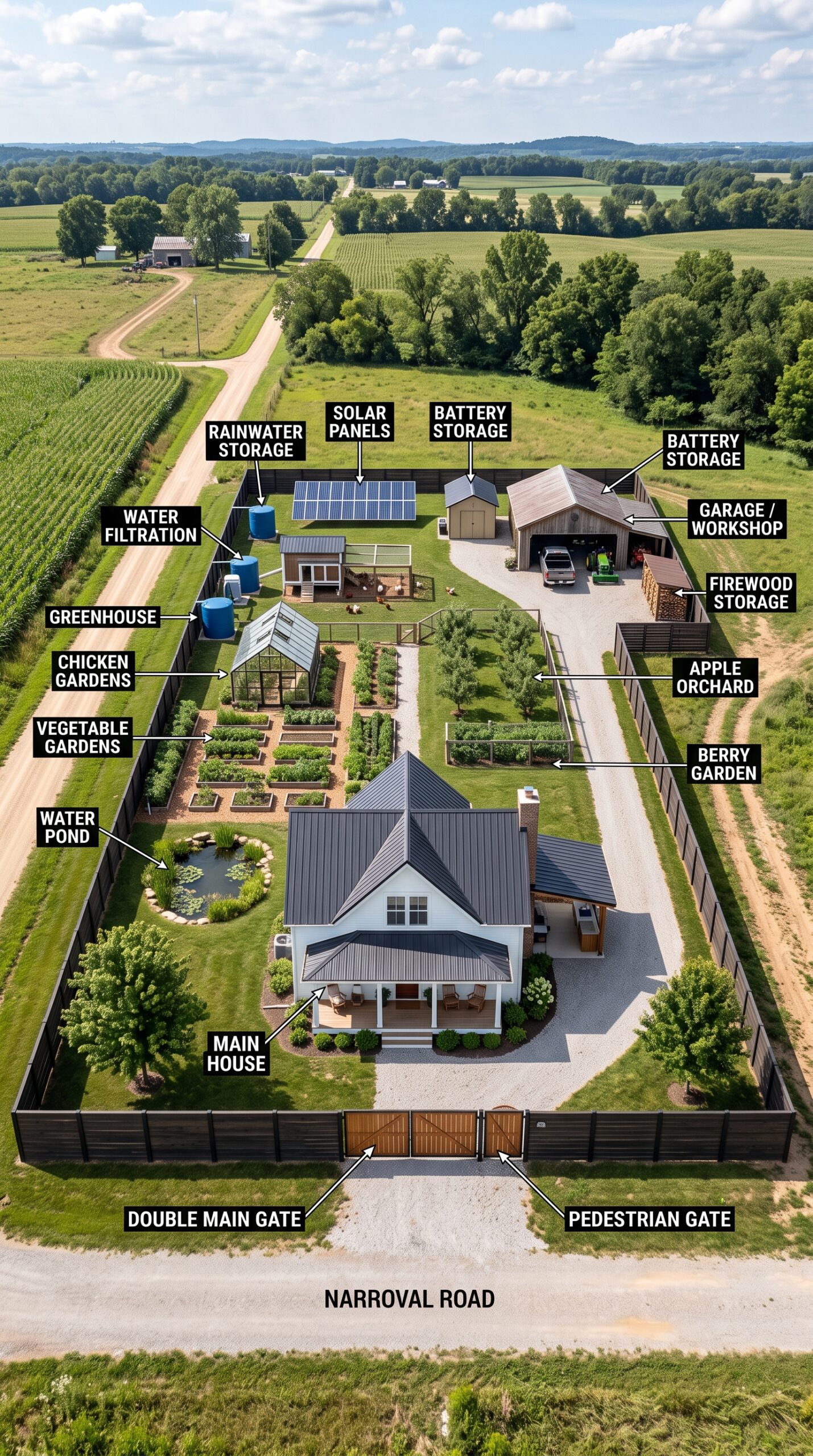
Imagine driving away from the nearest town and arriving at a private property surrounded by farmland, forests, and open countryside. At the end of a quiet rural road stands a secure homestead designed not simply as a place to live, but as a small, self-sufficient system.
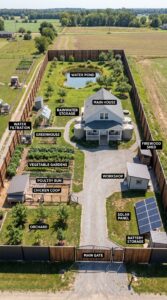
The property shown here combines a comfortable American farmhouse with food production, renewable energy, water storage, livestock facilities, workshops, and secure access. It is the kind of property that could provide a family with a remarkable degree of independence while still offering the comfort of a modern home.
But how much would it actually cost to build something like this in the United States?
The answer depends enormously on the state, land prices, local building requirements, the size of the house, and how sophisticated the infrastructure is. A modest version could potentially be built for several hundred thousand dollars, while a high-end version with substantial acreage, extensive infrastructure, and premium construction could easily exceed $1 million.
Here is what a project like this could look like.
A Private Rural Property
The first requirement is land.
A property like this would ideally be located in a rural part of the United States where acreage is still reasonably affordable and agricultural or residential development is permitted. Depending on the region, land prices can vary from relatively inexpensive parcels in parts of the Midwest and South to extremely expensive acreage near major metropolitan areas or desirable mountain and coastal regions.
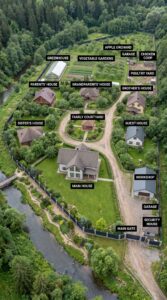
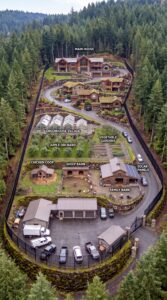
For this concept, imagine a property of approximately 3–10 acres. That would provide enough space for the main house, gardens, orchard, greenhouse, pond, workshop, solar installation, storage buildings, and livestock area without requiring an enormous ranch.
A rough land budget could range from $50,000 to $300,000 or more, depending heavily on location.
The most important thing would not necessarily be finding the cheapest land. A good property needs reliable road access, suitable soil, drainage, water potential, sunlight, and enough usable flat or gently sloping ground for construction.
Before purchasing, a buyer would also need to investigate zoning, septic requirements, well permits, flood zones, easements, property access, agricultural restrictions, and local building codes.
The Main House
At the center of the property is the main house.
The design shown in the concept is intentionally practical rather than extravagant. It resembles a modern American rural farmhouse with a pitched metal roof, covered front porch, multiple bedrooms, a large kitchen and living area, and enough interior space for a family to live comfortably year-round.
A house of approximately 2,000–3,000 square feet would be enough for many families.
Construction costs in the United States vary considerably, but a reasonable planning range for a quality rural home could be approximately $250,000–$600,000, excluding expensive land and some site-development costs.
The final price could be considerably higher in expensive states or if the homeowner chooses custom architecture, premium finishes, large amounts of glass, high-end kitchens, luxury bathrooms, or unusually complex foundations.
For a self-sufficient property, however, it can make sense to spend money on infrastructure rather than unnecessary luxury.
Good insulation, efficient windows, a durable roof, efficient heating and cooling, backup power, and a well-designed mechanical system can provide more long-term value than expensive decorative finishes.
The Security Fence and Main Gate
One of the most noticeable elements of the property is the perimeter fence.
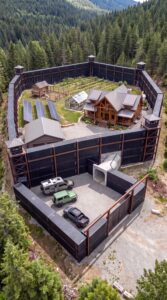
Instead of a simple backyard fence, the concept uses a substantial privacy and security barrier surrounding the property. The main entrance includes a large vehicle gate along with a separate pedestrian gate.
A secure perimeter can serve several purposes. It can define the property boundary, provide privacy, keep livestock inside, prevent pets from wandering onto the road, and create an additional layer of security.
A long perimeter fence can become surprisingly expensive.
Depending on the material, height, terrain, gates, posts, concrete work, and installation, several hundred feet of quality fencing could easily cost $20,000–$75,000+.
A heavy vehicle gate with automation, cameras, lighting, intercom access, and reinforced posts could add several thousand dollars more.
For a rural property, the gate could also include a keypad, remote controls, vehicle detection, and backup manual access.
The goal is not to create a fortress. It is to create a clearly controlled entrance while keeping the property functional and attractive.
Solar Power and Battery Storage
One of the most important systems shown in the concept is the solar installation.
A ground-mounted solar array occupies a portion of the property and provides electricity during daylight hours. Nearby battery storage allows energy to be used after sunset and provides additional resilience during grid outages.
A residential solar system could range from a relatively small 8–10 kW installation to a much larger 20–30 kW system depending on the family’s electricity consumption.
A complete solar-plus-battery installation could realistically cost $40,000–$100,000+ before considering potential incentives, depending on system size and equipment.
The exact configuration would need to be designed around the household’s energy requirements.
A normal house with efficient appliances requires much less energy than a property operating large workshops, refrigeration systems, pumps, electric vehicles, agricultural equipment, and other heavy loads.
Battery storage is particularly important because solar panels themselves do not provide electricity at night.
For maximum resilience, the property could also retain a backup generator. The generator would not necessarily operate continuously. Instead, it could provide emergency power during extended periods of poor weather or unusually high energy demand.
Rainwater Collection and Water Storage
Water is arguably more important than electricity when designing a self-sufficient property.
The concept includes large rainwater storage tanks positioned near the house and utility areas.
Rainwater can be collected from roofs and directed through gutters into storage tanks. Depending on local regulations, collected rainwater can potentially be used for irrigation, landscaping, livestock, and other non-potable purposes.
A separate water treatment system can provide additional filtration.
However, a real American property would need to follow local and state regulations regarding rainwater collection and potable water systems. In many locations, the most reliable primary water source would still be a properly constructed private well.
A complete well system, pressure tank, pumps, filtration, storage, and associated infrastructure could cost $10,000–$30,000 or more, depending on drilling depth and local conditions.
Rainwater storage could add another $5,000–$20,000+ depending on capacity and installation.
The ideal approach is redundancy: well water as the primary source, stored rainwater for appropriate uses, and enough reserve capacity to handle temporary interruptions.
Water Filtration
The property also contains a dedicated water filtration area.
This is an important detail because having access to water does not automatically mean having high-quality drinking water.
A filtration system could include sediment filtration, carbon filtration, water softening, UV treatment, or reverse osmosis depending on the results of laboratory water testing.
A whole-house treatment system might cost several thousand dollars, while more advanced multi-stage systems could cost considerably more.
The correct system should be selected based on the actual chemistry and microbiology of the water rather than simply purchasing the most expensive equipment.
For a self-sufficient homestead, maintaining spare filters and critical replacement components would also be sensible.
The Greenhouse
Next to the vegetable gardens is a dedicated greenhouse.
The greenhouse extends the growing season and provides a controlled environment for crops that might otherwise struggle in the local climate.
A modest greenhouse can be relatively inexpensive, but a permanent high-quality structure with a strong frame, glazing, ventilation, irrigation, heating, and climate controls can become a significant investment.
A good greenhouse for a property like this might cost approximately $8,000–$30,000, depending on size and construction.
The advantage is not simply growing vegetables during summer.
A greenhouse can be used to start seedlings early in the year, extend production into fall, protect sensitive crops from weather, and potentially provide fresh greens during colder months.
Vegetable Gardens
The vegetable gardens are one of the most productive parts of the property.
Instead of relying entirely on a large field, the concept uses organized raised and in-ground growing beds. This makes it easier to rotate crops, manage irrigation, control weeds, and harvest efficiently.
A well-planned garden could produce tomatoes, potatoes, onions, carrots, lettuce, cabbage, beans, peas, peppers, squash, cucumbers, herbs, and many other crops.
The initial cost could be surprisingly modest compared with the rest of the property.
A substantial garden with fencing, irrigation, soil preparation, raised beds, composting infrastructure, tools, and storage might cost $5,000–$20,000 to establish.
The real investment is labor.
Growing food at scale requires regular planting, watering, pruning, harvesting, pest management, soil improvement, and preservation.
But once established, the garden can dramatically increase the property’s food production.
Apple Orchard and Berry Garden
The property also includes an orchard.
Fruit trees take more patience than annual vegetables, but once established they can produce food for many years.
Apple trees are particularly suitable for many parts of the United States, although the appropriate varieties depend on climate and disease pressure.
The orchard could also include pears, plums, peaches, cherries, or other regionally appropriate fruit.
A berry garden could provide raspberries, blackberries, blueberries, currants, strawberries, or similar crops.
The initial planting cost might be only a few thousand dollars, but irrigation, deer protection, soil preparation, fencing, and maintenance can increase the total.
The biggest advantage is that an orchard transforms part of the property into a long-term food-producing asset.
Chicken Coop and Poultry Run
The homestead also includes a chicken coop and enclosed poultry run.
Chickens are one of the simplest forms of small-scale livestock for a rural property.
They require relatively little space compared with larger farm animals and can provide eggs, meat where permitted and desired, and manure for composting.
A well-built chicken coop with an enclosed predator-resistant run might cost approximately $3,000–$10,000, depending on size and construction.
The enclosure is particularly important because rural properties can have predators such as foxes, raccoons, coyotes, hawks, and other wildlife.
Feed storage should also be protected from rodents and moisture.
The poultry system does not make the property completely independent, since chickens still require feed, veterinary care, and replacement supplies, but it can significantly increase household food production.
Water Pond
Near the center of the property is a small pond.
A pond can serve several purposes: supporting wildlife, providing an emergency water reserve where legally appropriate, improving the landscape, and creating habitat for beneficial species.
Constructing a pond is not simply a matter of digging a hole.
Soil conditions, watershed, drainage, environmental restrictions, water rights, and local regulations all need to be considered.
A small agricultural or recreational pond could cost $10,000–$50,000+ depending on excavation requirements, soil conditions, size, and accessibility for construction equipment.
The pond would also require maintenance and careful management to prevent erosion and water-quality problems.
Garage and Workshop
At the rear of the property is a large garage/workshop.
This may be one of the most useful structures on the entire homestead.
A workshop allows the owner to repair equipment, maintain vehicles, build garden infrastructure, store tools, and perform woodworking or mechanical projects without using the main house.
A detached garage or workshop of approximately 1,000–2,000 square feet could cost roughly $80,000–$200,000+, depending on construction quality and local labor costs.
The interior could include workbenches, storage cabinets, a utility sink, electrical outlets, compressed air, welding equipment, woodworking tools, spare parts, and agricultural equipment.
For a self-sufficient property, the workshop is not simply a hobby room. It becomes the place where the owner maintains the systems that keep the property functioning.
Firewood Storage
The firewood structure may look simple, but it serves an important role.
If the house uses a wood stove, fireplace, or wood-fired heating system, dry firewood must be stored under cover.
A properly designed woodshed protects the supply from rain and snow while allowing ventilation.
Depending on local climate and heating requirements, a family could store several cords of firewood.
A basic woodshed could cost only a few thousand dollars, especially if built by the homeowner.
Tool Storage
A separate tool shed keeps gardening and maintenance equipment organized.
This could hold lawn equipment, hand tools, hoses, wheelbarrows, irrigation equipment, fencing supplies, pruning tools, and other items.
Separating everyday tools from the main workshop keeps the property more efficient and reduces the need to constantly move equipment between buildings.
A basic shed could cost approximately $2,000–$8,000.
Roads and Site Development
One of the easiest costs to underestimate is everything between the buildings.
The property needs driveways, parking areas, drainage, walkways, utility trenches, grading, landscaping, and potentially internal gravel roads.
A long gravel driveway might cost tens of thousands of dollars depending on length and local material prices.
If the property requires significant grading, retaining walls, culverts, drainage improvements, or paved surfaces, the budget can increase rapidly.
For a property like this, it would be reasonable to reserve $30,000–$100,000+ for roads, grading, drainage, landscaping, and general site development.
What Would the Entire Project Cost?
So what is the final number?
For a realistic American version of this concept, a rough budget might look something like this:
- Rural land: $50,000–$300,000+
- Main house: $250,000–$600,000+
- Perimeter fencing and gates: $20,000–$75,000+
- Solar and batteries: $40,000–$100,000+
- Well and water infrastructure: $10,000–$30,000+
- Rainwater storage and filtration: $10,000–$30,000+
- Greenhouse: $8,000–$30,000
- Vegetable gardens and irrigation: $5,000–$20,000
- Orchard and berry garden: $3,000–$15,000
- Chicken coop and poultry run: $3,000–$10,000
- Pond: $10,000–$50,000+
- Garage/workshop: $80,000–$200,000+
- Firewood and tool storage: $5,000–$15,000
- Roads, grading and landscaping: $30,000–$100,000+
That puts a broad conceptual total somewhere around $524,000 to well over $1.5 million, depending heavily on land, location, construction standards, and how much of the work is completed by contractors versus the property owner.
A more realistic target for a comfortable, well-equipped version in a moderately priced rural area might be around $700,000–$900,000.
And this is exactly why location matters so much.
The same concept could be dramatically cheaper in a rural part of the Midwest than in an expensive area of California, New York, Washington, or Colorado.
Is It Really Self-Sufficient?
There is an important distinction between being self-sufficient and being more independent.
Even a property with solar panels, gardens, chickens, rainwater storage, and an orchard will still depend on the outside world.
The owners will probably purchase fuel, tools, medicines, replacement parts, animal feed, seeds, building materials, electronics, and many other products.
The goal is not necessarily to eliminate every connection with civilization.
Instead, the objective is to create redundancy.
If the electrical grid goes down, the batteries and generator can keep essential systems operating.
If grocery prices rise, the gardens and orchard can provide some food.
If there is a temporary water problem, stored water provides additional resilience.
If equipment breaks, the workshop gives the owner the ability to repair many things without immediately calling a contractor.
And if a storm blocks the road for several days, having food, water, power, and basic supplies already on the property becomes extremely valuable.
That is what makes a homestead like this interesting.
It is not simply a beautiful rural house.
It is an entire system designed around resilience.
The Biggest Advantage Is the Land
Perhaps the most valuable part of the project is not the solar array, greenhouse, or workshop.
It is the land itself.
A properly selected rural property can provide space for food production, water management, renewable energy, recreation, storage, livestock, and future expansion.
The owner could start with a relatively simple house and garden and gradually add infrastructure over many years.
The solar system could be expanded.
More fruit trees could be planted.
The garden could become larger.
Additional storage buildings could be added.
A second greenhouse could be constructed.
More livestock could be introduced if zoning and the owner’s goals allow it.
This makes the property fundamentally different from a normal suburban home.
A suburban backyard has limitations.
A rural homestead has room to evolve.
The Dream of a Modern American Homestead
The most interesting thing about this design is that it combines two very different ideas.
On one side, there is traditional rural living: gardens, chickens, fruit trees, firewood, workshops, and a farmhouse.
On the other side, there is modern technology: solar panels, battery storage, water filtration, automated gates, modern construction, efficient appliances, and sophisticated infrastructure.
Together, they create a modern interpretation of the American homestead.
It does not require abandoning modern life.
Instead, it uses modern technology to make rural living more resilient and comfortable.
You can still have high-speed internet, modern appliances, air conditioning, a comfortable kitchen, and a well-designed home while producing some of your own food and electricity.
And that may be the most realistic vision of self-sufficient living for the future.
Not complete isolation.
Not going completely off-grid.
But having enough resources and infrastructure on your own land that a temporary disruption outside the property does not immediately become a crisis.
Would You Build a Property Like This?
For roughly $700,000–$900,000 in a suitable part of rural America, a project like this could potentially create far more than a house.
It could become a private family homestead with its own gardens, orchard, greenhouse, poultry area, workshop, water systems, renewable energy, storage, and secure perimeter.
It would require significant planning, money, maintenance, and years of work.
But once completed, the property could provide something that is increasingly difficult to find: space, privacy, resilience, and a degree of independence from the systems surrounding it.
The real question is not whether you could afford to build it.
Would you actually want to live here?
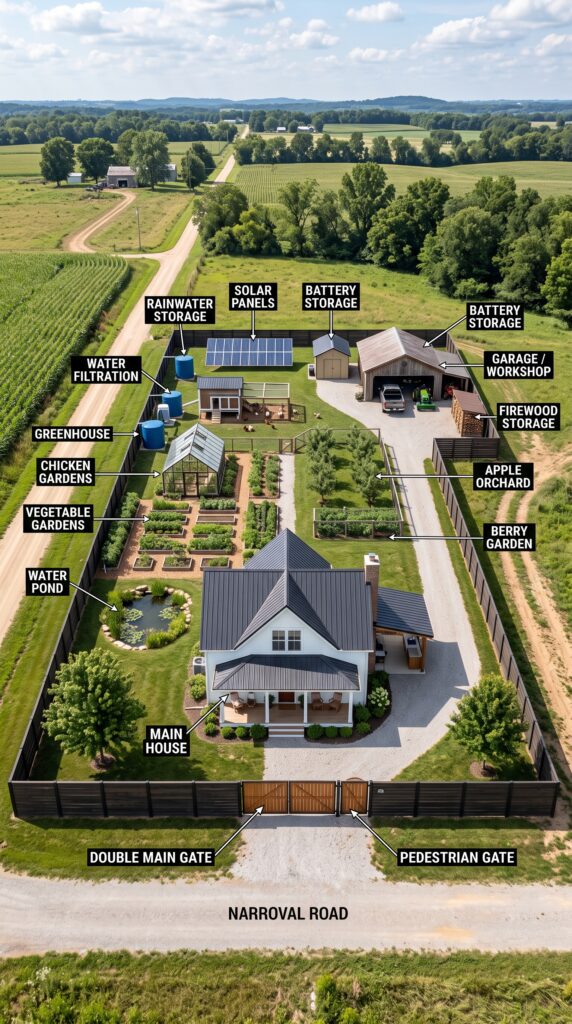
This project is a conceptual design created for inspiration and architectural visualization. It is not a real construction project or a technical blueprint.
Leave a Reply