What Would It Cost to Build a Fully Self-Sufficient Family Homestead Like This in the American Countryside?
At first glance, this property might look like an ordinary rural American home surrounded by farmland. But take a closer look and it becomes clear that this is much more than a house with a large backyard.
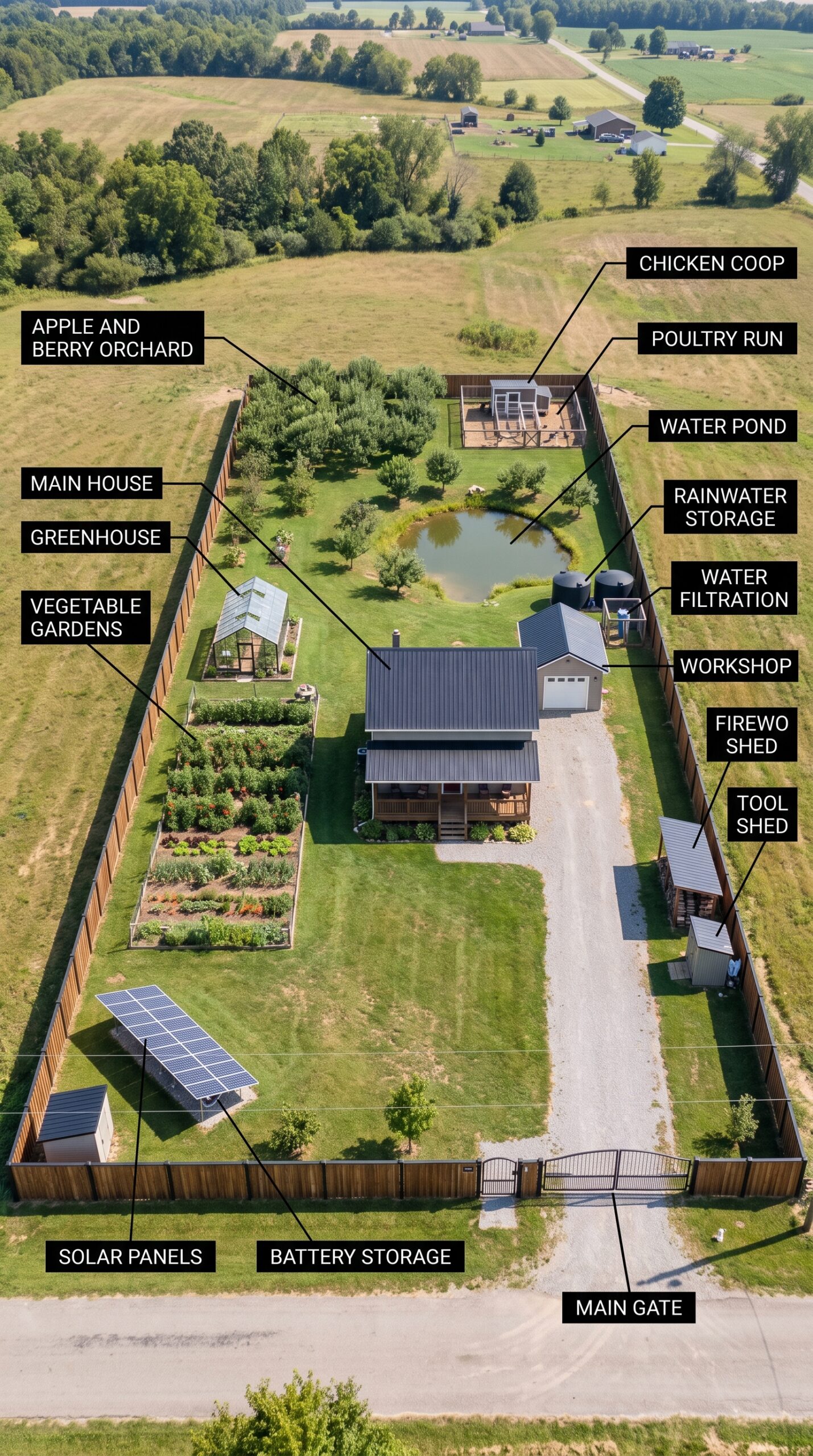
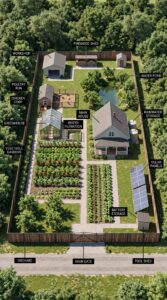
The entire property has been designed as a self-sufficient family homestead, combining food production, water management, renewable energy, livestock, workshops and storage into one private compound.
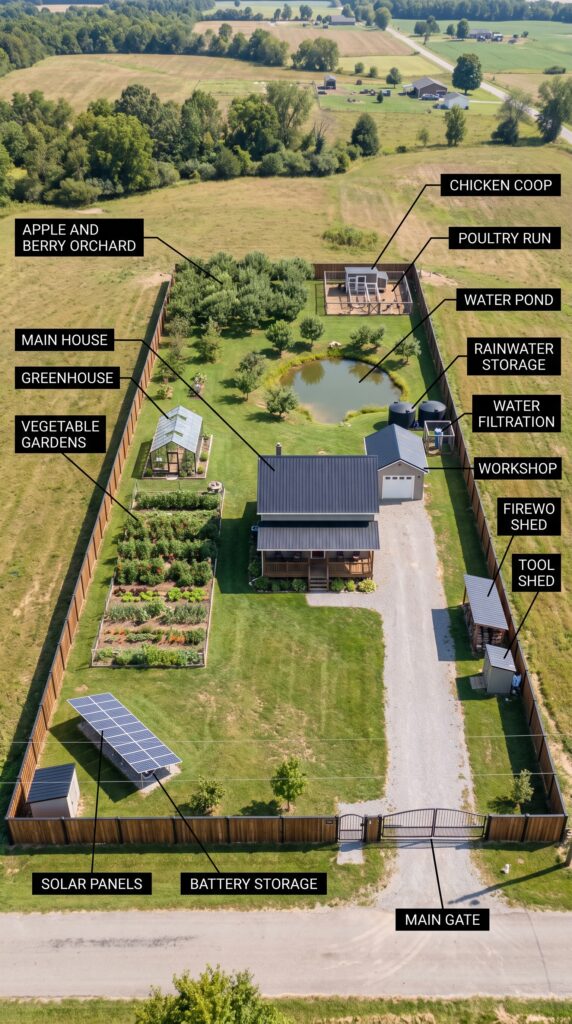
There is a main house in the center of the property, a large vegetable garden, a greenhouse, an apple and berry orchard, a chicken coop with a dedicated poultry run, a private water pond, rainwater storage tanks, water filtration, solar panels, battery storage, a workshop, a firewood shed and a separate tool shed.
The entire property is enclosed by a tall wooden privacy fence, with a large main gate providing controlled access from the rural road.
It is the kind of place where a family could produce a significant portion of its own food, generate part of its own electricity and maintain many of the systems necessary for everyday life without depending entirely on nearby infrastructure.
But how much would something like this actually cost to build in the United States?
The answer depends enormously on the state, land prices, local construction costs, the size and quality of the house, permitting requirements and how sophisticated the infrastructure is. A property like this could be relatively modest in one rural area and extraordinarily expensive in another.
Still, we can break the concept down and get a realistic idea of where the money would go.
The Main House
The largest and most expensive structure on the property would naturally be the main house.
The house shown in the concept is a comfortable rural home with a covered porch, multiple bedrooms, a large kitchen and living areas, utility spaces and enough room for a family to live comfortably year-round.
For an American custom-built home, construction costs can vary dramatically. A practical rural house might cost several hundred thousand dollars, while a larger custom home with upgraded materials, high-efficiency systems and extensive interior finishing could easily move toward or beyond the million-dollar range.
For a property of this scale, a reasonable planning figure could be $450,000–$800,000 for the main house, depending on its size and specifications.
That figure could increase substantially if the owners wanted premium stonework, custom cabinetry, high-end appliances, geothermal heating, extensive backup systems or other luxury features.
The location also matters.
Building in a remote rural area may reduce land costs, but it can increase construction expenses because contractors, materials and heavy equipment have farther to travel.
The Land
Before building anything, you need somewhere to put it.
A property like this would probably require several acres, especially if the goal is to have enough space for gardens, orchards, livestock and privacy.
The exact land requirement depends on the design. The illustrated property could potentially fit on a relatively compact acreage, while a more agricultural version could require 10, 20 or even 50 acres.
Land prices in the United States vary enormously.
A few acres in an inexpensive rural county could cost tens of thousands of dollars. The same amount of land near a major metropolitan area or in a highly desirable state could cost hundreds of thousands or even millions.
For a hypothetical rural project, it would be reasonable to allocate $100,000–$300,000 or more for the land, while recognizing that this number can be dramatically different depending on location.
And then there is the question of whether the property already has road access, electricity, a well, septic system and other utilities.
If it doesn’t, the budget starts climbing quickly.
The Privacy Fence
One of the most noticeable features of the property is the perimeter fence.
This isn’t simply a decorative garden fence. It creates a clearly defined private boundary around the entire homestead.
A tall wooden privacy fence could require a surprisingly large budget once you account for posts, concrete, framing, panels, gates, labor and terrain preparation.
On a larger property, fencing can easily become one of the major infrastructure expenses.
A rough project allowance could be $30,000–$80,000+, depending on the perimeter length, materials and whether the owners choose standard fencing or a much heavier custom installation.
The main entrance would also require a substantial gate capable of accommodating vehicles and equipment.
The Vegetable Gardens
The vegetable gardens are one of the most practical parts of the entire property.
Instead of relying entirely on a grocery store, the family could grow tomatoes, potatoes, onions, carrots, lettuce, peppers, cucumbers, squash, beans and many other seasonal crops.
The garden is divided into organized growing beds, making crop rotation and irrigation easier.
A serious garden also requires more than soil and seeds.
There would need to be irrigation lines, water connections, raised beds or prepared soil, composting areas, fencing and possibly drainage systems.
Depending on how much work the owners perform themselves, establishing a substantial vegetable garden could cost anywhere from a few thousand dollars to tens of thousands.
A professionally installed version with irrigation and prepared growing beds might be around $10,000–$30,000.
Once established, however, the garden could provide food year after year with much lower annual costs.
The Greenhouse
The greenhouse takes the idea of self-sufficiency one step further.
It could extend the growing season and allow the family to produce vegetables earlier in spring and later in autumn. In colder regions, it could become particularly valuable.
A small hobby greenhouse can be relatively inexpensive, but the structure shown here is considerably more substantial.
A high-quality greenhouse with a solid foundation, ventilation, irrigation and climate-control equipment could easily cost $15,000–$50,000+.
A sophisticated greenhouse designed for year-round production could cost considerably more.
The real value isn’t only the structure itself. It is the ability to produce food during periods when outdoor gardens are less productive.
The Orchard
The property also includes an apple and berry orchard.
Fruit trees require patience. Unlike annual vegetables, you cannot simply plant an apple tree in spring and expect a large harvest a few months later.
Depending on the varieties selected, trees may take several years to become productive.
The initial cost includes trees, soil preparation, irrigation, protective fencing, mulch and ongoing maintenance.
For a relatively small family orchard, $5,000–$20,000 could be a reasonable starting range, although a larger commercial-style orchard could cost substantially more.
Once established, the orchard could provide apples, berries and other fruit for many years.
The family could also preserve the harvest through canning, freezing, drying or making products such as apple sauce and jams.
Chickens and the Poultry Area
At the far end of the property is a dedicated chicken coop and poultry run.
Keeping chickens can provide a regular supply of fresh eggs and, depending on the setup and local regulations, potentially meat as well.
The important part is creating a secure environment with shelter, ventilation, nesting boxes, feeding areas and protection from predators.
A basic chicken setup can be built relatively cheaply, particularly if the owners do the work themselves.
A more permanent structure with a professionally constructed run might cost approximately $5,000–$15,000.
The ongoing expenses would include feed, bedding, veterinary care and replacement birds.
But compared with many other components of the property, livestock infrastructure is relatively inexpensive.
The Private Water Pond
The pond is one of the most interesting features of the design.
It provides a water feature for the property and could potentially serve practical purposes depending on local regulations, water availability and how the system is engineered.
Constructing a pond isn’t simply a matter of digging a hole.
The site needs to be evaluated for soil conditions, drainage, water sources and environmental requirements. Excavation equipment may be required, and the pond may need grading, liners or other measures to prevent unwanted water loss.
A small decorative or functional pond could cost several thousand dollars, while a professionally engineered pond can easily reach $20,000–$50,000 or more.
The pond could also become an attractive natural centerpiece for the homestead, surrounded by trees, grass and walking paths.
Rainwater Storage
Next to the main house are large rainwater storage tanks.
The concept is straightforward: instead of allowing rainwater to disappear into the ground or drainage system, water falling on the roofs can be collected and stored.
The stored water can potentially be used for irrigation and other approved purposes, subject to local regulations and proper treatment.
A complete system requires gutters, filtration, pumps, storage tanks and plumbing.
A practical system might cost $10,000–$30,000+, depending on capacity and complexity.
In areas with regular rainfall, this could significantly reduce the amount of municipal or well water needed for irrigation.
Water Filtration
Water independence also requires water treatment.
The property includes a dedicated filtration area that could be connected to a well, rainwater system or other approved source.
A residential water filtration system can range from a relatively simple setup to a sophisticated multi-stage treatment system.
For a property designed around redundancy and self-sufficiency, a budget of $5,000–$20,000 for filtration, pumps, tanks and related equipment would not be unreasonable.
The exact system would need to be designed around the actual water source and local water-quality requirements.
Solar Power
One of the most important infrastructure investments is the solar array.
The property shown here uses ground-mounted solar panels positioned in an open section of the land.
The panels could provide electricity during daylight hours, while excess production could be stored in batteries.
The size of the system would depend on the home’s electricity consumption and how much of the property the owners want to power.
A typical residential solar installation might cost tens of thousands of dollars, while a larger off-grid or hybrid system with substantial battery storage could move into the $50,000–$150,000+ range.
Battery storage is particularly important if the goal is resilience.
Solar panels only generate electricity when conditions allow. Batteries provide a way to store energy for nighttime use or periods of reduced sunlight.
For a serious backup system, battery storage could represent $20,000–$60,000 or more by itself.
The Workshop
A property like this needs somewhere to repair equipment, maintain tools and work on projects.
That is where the workshop comes in.
The workshop could be used for woodworking, equipment maintenance, gardening projects, repairs and general property management.
A basic detached workshop might cost $30,000–$60,000, while a larger structure with insulation, electrical service, heating, storage and specialized equipment could easily exceed $100,000.
For a working homestead, however, the workshop could become one of the most frequently used buildings on the property.
Firewood and Tool Storage
The firewood shed and separate tool shed may look small compared with the house, but they serve important functions.
A property in a rural area may use firewood for heating, fireplaces or outdoor cooking. Keeping it properly covered and ventilated helps protect the wood from moisture.
The tool shed provides dedicated storage for lawn equipment, gardening tools, chainsaws, hoses and other equipment that would otherwise clutter the main house or workshop.
Together, these structures might cost $5,000–$15,000, depending on their size and construction.
Roads and Drainage
Another expense that is easy to overlook is everything between the buildings.
The property needs an internal driveway, parking areas, walking paths and drainage.
The driveway shown in the concept connects the main gate with the house, workshop and other structures.
Gravel is cheaper than asphalt or concrete, but even a gravel road can become expensive when substantial grading and drainage work are required.
For a larger rural property, $20,000–$75,000+ could be allocated for roads, parking areas, drainage and site preparation.
If the terrain is difficult, the number could be much higher.
Landscaping
The final result also depends heavily on landscaping.
Trees, lawns, flower beds, paths, retaining walls and drainage features turn the property from a collection of buildings into a cohesive homestead.
The concept shows carefully maintained grass around the main house, organized garden beds, fruit trees and landscaped areas around the pond.
Professional landscaping on this scale could easily cost $30,000–$100,000+.
Doing much of the planting personally could reduce the initial cost considerably, especially if the family is willing to develop the property gradually.
A Realistic Total
When all of these components are added together, the project becomes much more expensive than simply buying a rural house.
A rough hypothetical budget might look something like this:
Land: $100,000–$300,000+ Main house: $450,000–$800,000+ Privacy fencing and gates: $30,000–$80,000+ Gardens: $10,000–$30,000 Greenhouse: $15,000–$50,000+ Orchard: $5,000–$20,000 Chicken facilities: $5,000–$15,000 Pond: $20,000–$50,000+ Rainwater system: $10,000–$30,000+ Water filtration: $5,000–$20,000 Solar and batteries: $50,000–$150,000+ Workshop: $30,000–$100,000+ Storage buildings: $5,000–$15,000 Roads and site work: $20,000–$75,000+ Landscaping and miscellaneous infrastructure: $30,000–$100,000+
That puts a realistic conceptual total somewhere around $800,000 to well over $1.8 million, before considering unusually expensive land, luxury finishes or major unforeseen construction costs.
In a lower-cost rural area, a family could potentially create a smaller version for considerably less by buying an existing house, performing much of the landscaping themselves and expanding the property gradually.
And that may actually be the smartest approach.
You don’t necessarily need to build everything at once.
A family could start with a house and several acres. Then install a garden. Add fruit trees the following year. Build a greenhouse. Add chickens. Install solar panels. Construct a workshop. Expand water storage. Eventually, the property could evolve into something remarkably similar to the concept.
Would It Actually Be Self-Sufficient?
There is an important distinction between self-sufficient and partially self-sufficient.
Even a property this advanced would probably still depend on outside resources.
The family would need replacement parts, tools, medical supplies, fuel, certain foods, building materials and other products.
Solar panels don’t eliminate every electrical need. A vegetable garden doesn’t provide every calorie. Chickens don’t eliminate the need for animal feed. A pond doesn’t automatically provide safe drinking water.
True independence is extremely difficult.
What this type of property does provide is resilience.
If the power goes out, the solar system and batteries can keep important systems operating.
If grocery prices rise, the gardens and orchard can provide some food.
If water becomes scarce, stored rainwater can potentially supplement other sources.
If equipment breaks, the workshop provides a place to repair it.
If a storm cuts off the local road for a short period, the household has food, water and basic infrastructure already on site.
That is arguably the real appeal of the design.
It isn’t about disappearing from civilization completely.
It is about creating a property where a family has more control over the essentials of everyday life.
Could You Live Here?
Imagine waking up in the main house on a quiet summer morning.
Instead of looking out at a parking lot or neighboring buildings, you see your own orchard and gardens.
You walk outside and collect vegetables for breakfast. Fresh eggs come from the chicken coop. Rainwater collected from the roof is available for irrigation. Solar panels are producing electricity while the greenhouse continues growing crops.
Later, you could spend a few hours working in the workshop, maintaining equipment or repairing something around the property.
In the evening, you walk toward the pond while the sun sets over the surrounding countryside.
There are no apartment walls separating you from your neighbors.
No constant traffic.
No crowded backyard.
Just your family, your land and the systems you built around it.
Of course, maintaining a property like this would also be a huge amount of work.
Gardens need attention. Trees need pruning. Chickens need feeding. Fences need maintenance. Solar equipment needs inspection. Roads need repairs. Buildings age. Grass grows. Water systems need servicing.
This isn’t a place where you can simply lock the door and leave for six months.
It would be a lifestyle as much as a house.
But for someone who enjoys working with their hands and wants a quieter rural life, that could be exactly the point.
The most fascinating thing about this design isn’t any individual feature.
It is the way everything works together.
The house provides the living space. The gardens provide food. The orchard provides fruit. The greenhouse extends the growing season. The chickens provide eggs. The pond and rainwater system help manage water. Solar panels generate electricity. Batteries store it. The workshop allows repairs. The sheds provide storage. And the fence turns the entire property into one organized private homestead.
It is essentially a small private ecosystem designed around one goal: making everyday life more resilient and independent.
And if you had the land and the money to build it, the biggest question wouldn’t be whether you could afford the house.
It would be:
Would you actually want to live this way?
This project is a conceptual design created for inspiration and architectural visualization. It is not a real construction project or a technical blueprint.

Leave a Reply