How Much Will It Cost To Build An Autonomous Farm On 12 Acres?
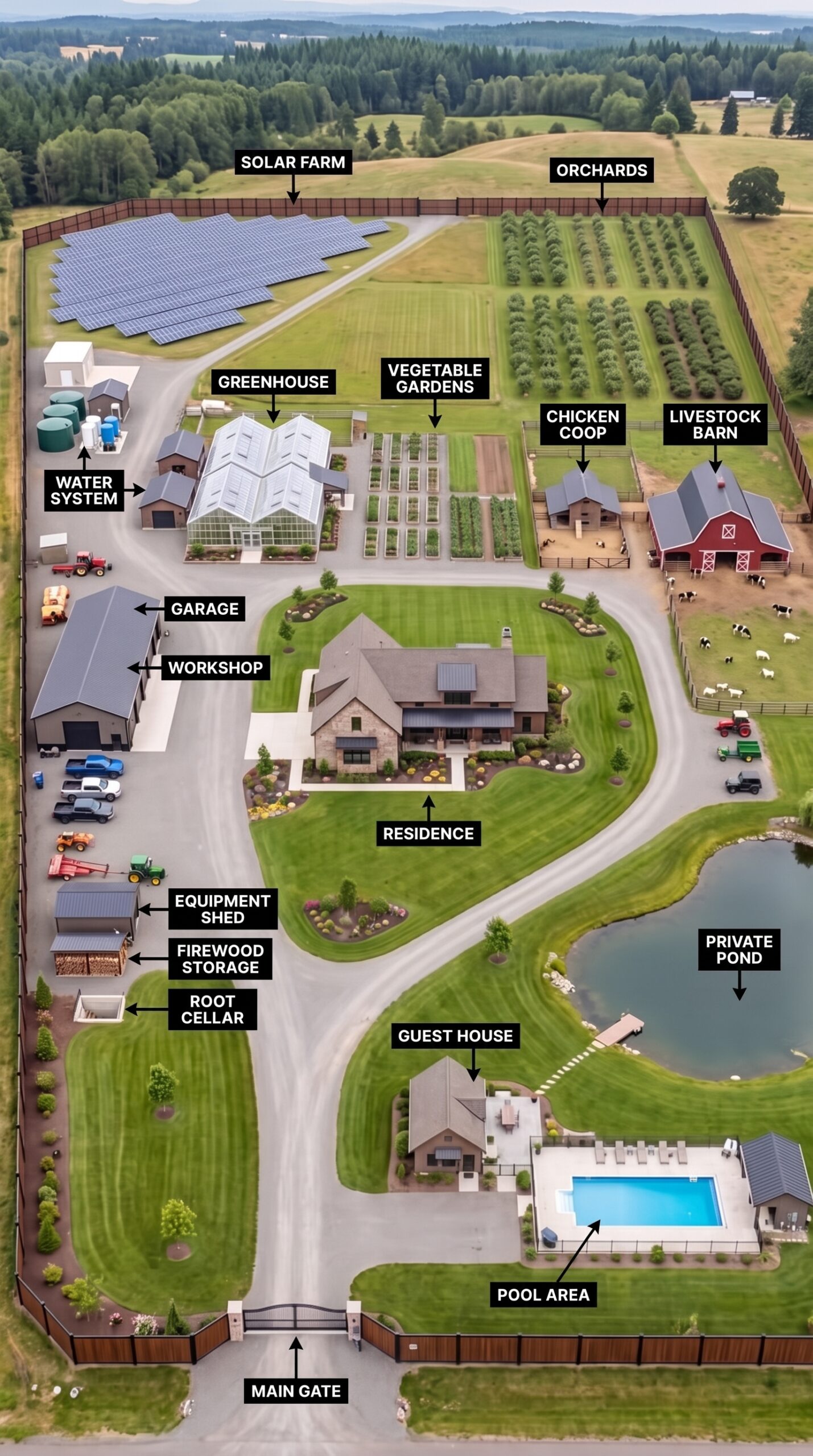
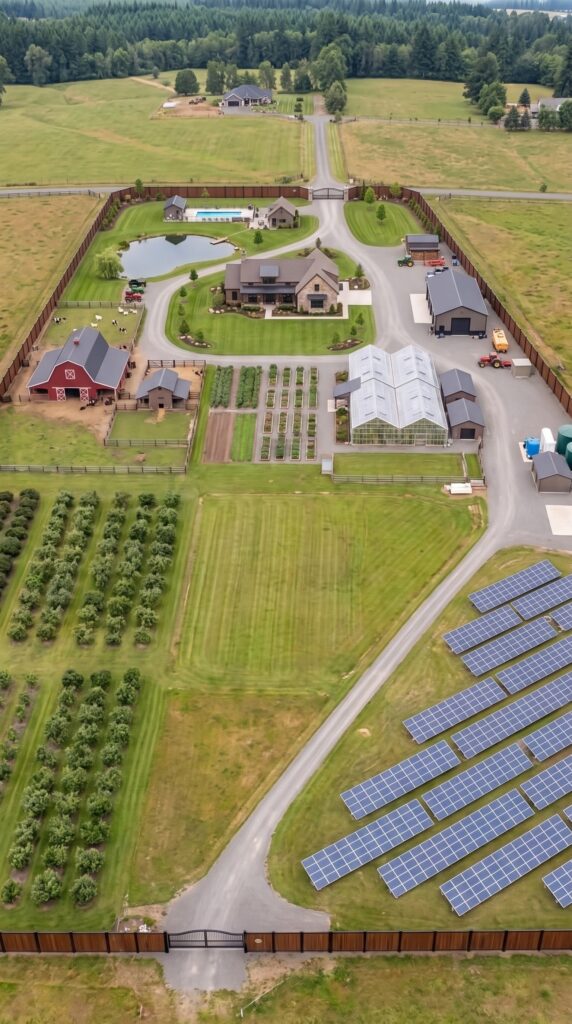
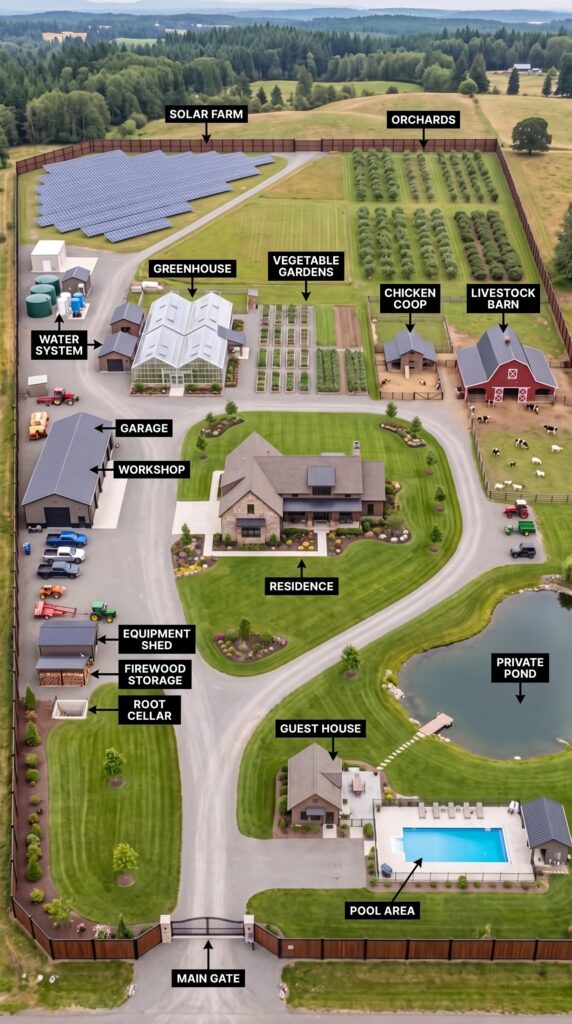
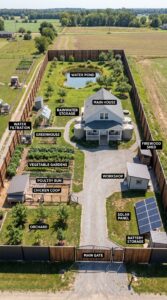
This property is designed as a complete family homestead where the main house, guest house, greenhouse, orchard, livestock areas, workshop, water systems, solar farm, pond and recreation areas all work together.
Instead of using the land only for a house and a large lawn, almost every section has a purpose. Some areas are dedicated to living, others to food production, some to energy and utilities, while the remaining space creates privacy and room for future expansion.
The result is closer to a small private estate and working farm than a conventional American country property.
Below is a realistic 2026 U.S. planning estimate for building a property similar to the one shown.
The 12-Acre Property
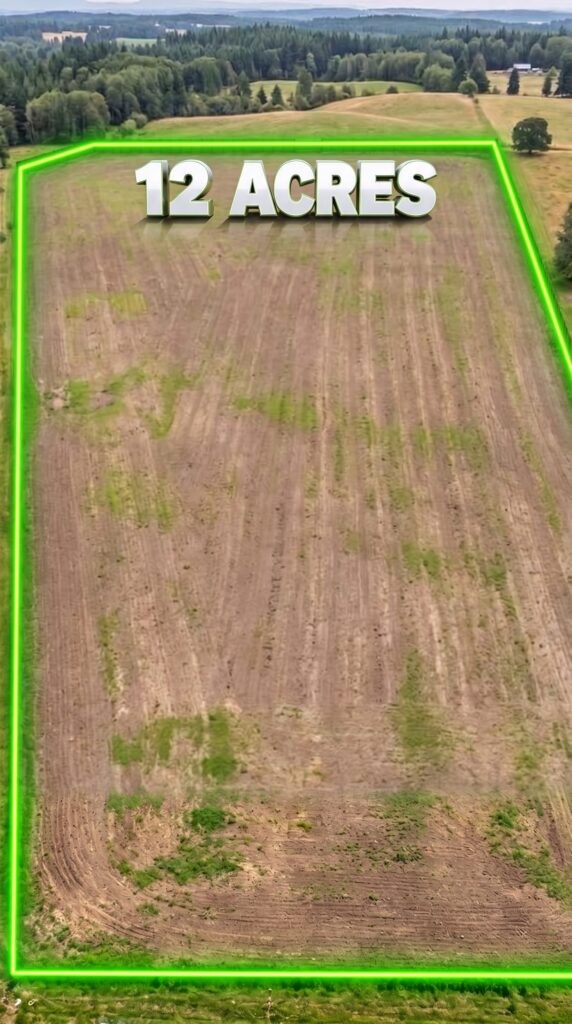
The first thing that makes this project interesting is the amount of land.
Twelve acres gives the family enough room to separate the residential areas from the agricultural and utility areas while still leaving significant open space.
The property in the concept includes a long private driveway, perimeter fencing, internal roads, lawns, orchards, vegetable gardens, livestock areas and a large solar field.
The cost of the land itself can vary enormously by state. For this calculation, the land is not included, because 12 acres of rural property in Texas, Tennessee, Missouri, Oregon or Washington could have completely different asking prices.
The construction budget below assumes that the land has already been purchased.
Estimated site development and land preparation: $150,000–$300,000
This includes grading, clearing selected areas, drainage, excavation, access roads and preparation for the major structures.
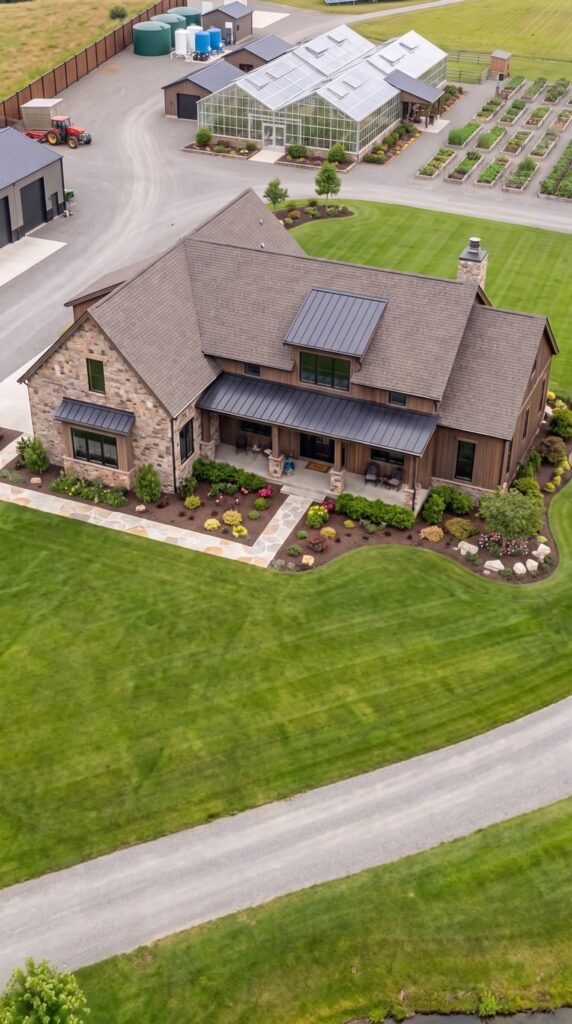
The Main Family Residence — $650,000–$950,000
The heart of the property is the main family residence.
The house shown in the concept is not a basic farmhouse. It has a custom rural-estate appearance with a mixture of natural stone, timber, large windows, multiple roof sections and a large covered entrance.
Inside, the layout could include several bedrooms, a large kitchen, dining room, family room, office space, laundry, multiple bathrooms and direct access to the outdoor areas.
A roughly 2,800–3,500 square-foot custom home in a rural U.S. market could reasonably land in the $650,000–$950,000 range depending on finishes and location. Current 2026 custom-home estimates can range from roughly $150 to $300+ per square foot in Georgia, with high-end custom construction exceeding that level.
The most expensive part is not necessarily the exterior. Kitchens, bathrooms, windows, mechanical systems, cabinetry, flooring and electrical work can quickly push a custom home into the upper end of the budget.
The Guest House — $180,000–$300,000
Near the private pond is a smaller guest house designed for relatives, friends or extended family.
This gives the property an important advantage: guests can stay comfortably without occupying the main family residence.
A 900–1,300 square-foot guest house with a kitchen, bedroom, bathroom, living area and covered outdoor space would fit the concept.
A realistic construction allowance is $180,000–$300,000, depending on the interior finish level and how much site infrastructure must be extended to the building.
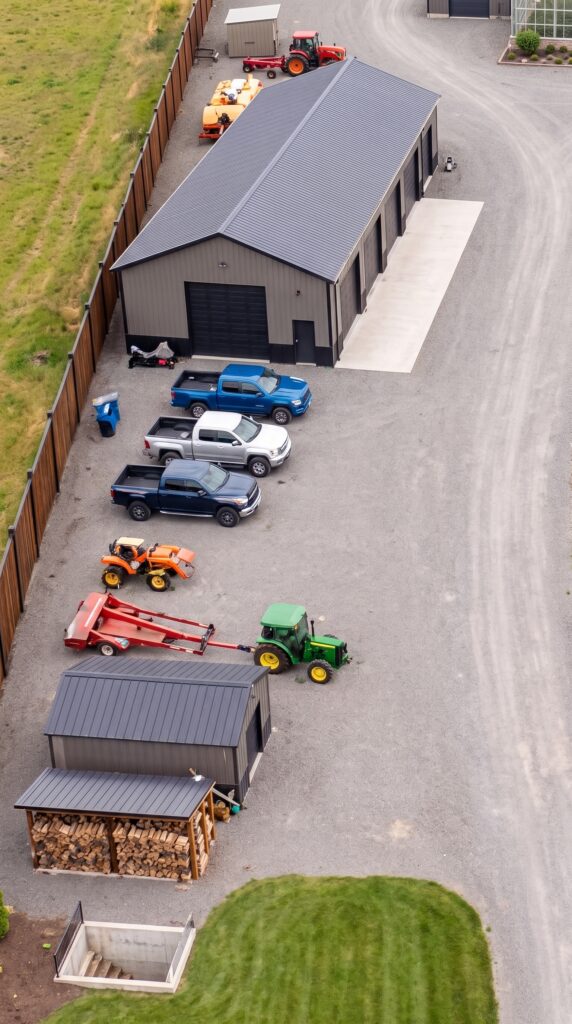
The Large Garage and Workshop — $220,000–$380,000
The garage is one of the most practical buildings on the property.
Unlike a normal residential garage, this structure is large enough for several vehicles, agricultural machinery, tools, storage and mechanical work.
The concept includes a spacious workshop with room for equipment, repair work and a vehicle lift.
A building in the roughly 3,500–4,500 square-foot range can become a significant project once you add a concrete slab, multiple large doors, electrical service, insulation, lighting, storage and workshop equipment.
A realistic allowance is $220,000–$380,000.
Basic agricultural buildings can be much cheaper, but a finished workshop designed for year-round use costs considerably more.
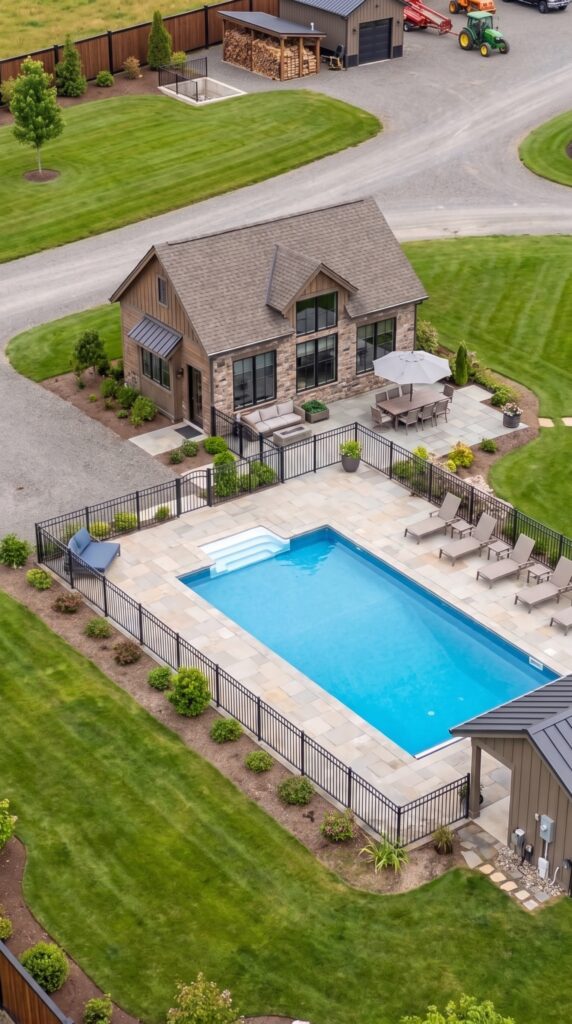
The Swimming Pool and Recreation Area — $70,000–$110,000
At the edge of the guest house is a large private swimming pool.
The pool is completely separate from the pond, giving the family a clean recreational area while the pond remains part of the property’s natural and agricultural system.
A standard 400-square-foot gunite pool in Georgia is currently estimated around $41,000–$55,000 before significant upgrades. A pool approximately twice that surface area, with substantial decking, fencing, landscaping and equipment, can easily move into the $70,000–$110,000 range.
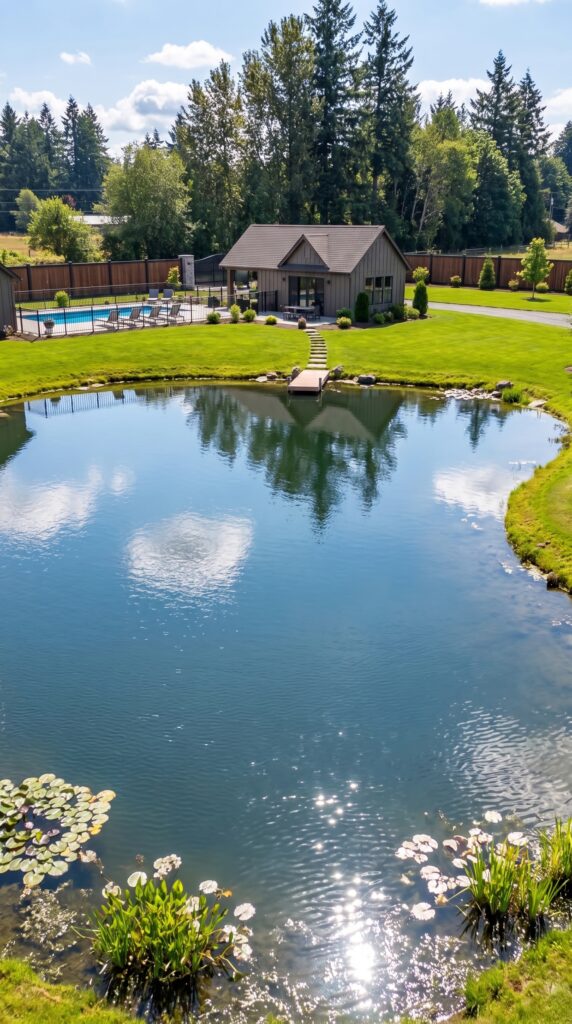
The Private Pond — $35,000–$75,000
The pond is one of the most visually impressive parts of the property.
It provides a completely different environment from the manicured lawns and agricultural fields.
The pond can be designed for recreational fishing and stocked with fish, while landscaped banks and a small dock turn it into a family recreation area.
Basic farm and fishing ponds can cost substantially less, but the finished version shown here includes excavation, shaping, drainage, bank stabilization, landscaping and water management.
A planning budget of $35,000–$75,000 is reasonable. Current U.S. pond estimates range from several thousand dollars for simple excavation to much higher amounts for engineered fishing and landscaped ponds.
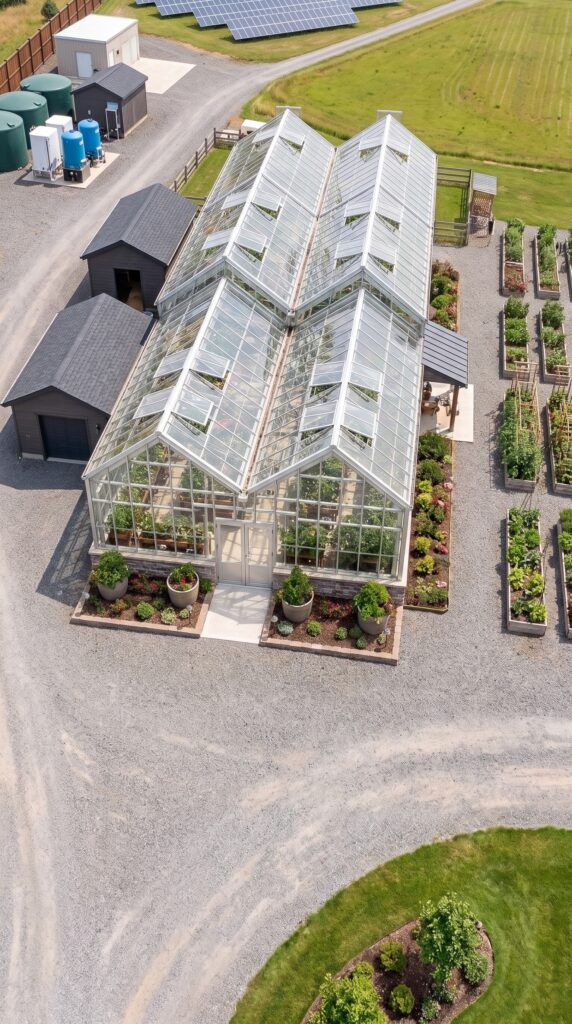
The Large Greenhouse — $120,000–$220,000
One of the most important agricultural structures is the large greenhouse.
This is not a small backyard structure. The concept shows a substantial glass greenhouse with dedicated growing areas, ventilation and enough interior space to produce vegetables on a serious scale.
Commercial greenhouse construction is currently estimated around $15–$40 per square foot for installed structures, with glass structures toward the higher end.
For a roughly 5,000–7,000 square-foot greenhouse with heating, irrigation, ventilation, electrical service and growing infrastructure, a reasonable budget is $120,000–$220,000.
The greenhouse also makes the homestead much more interesting economically because it can potentially produce food beyond what the family personally consumes.
Vegetable Gardens and Raised Beds — $20,000–$40,000
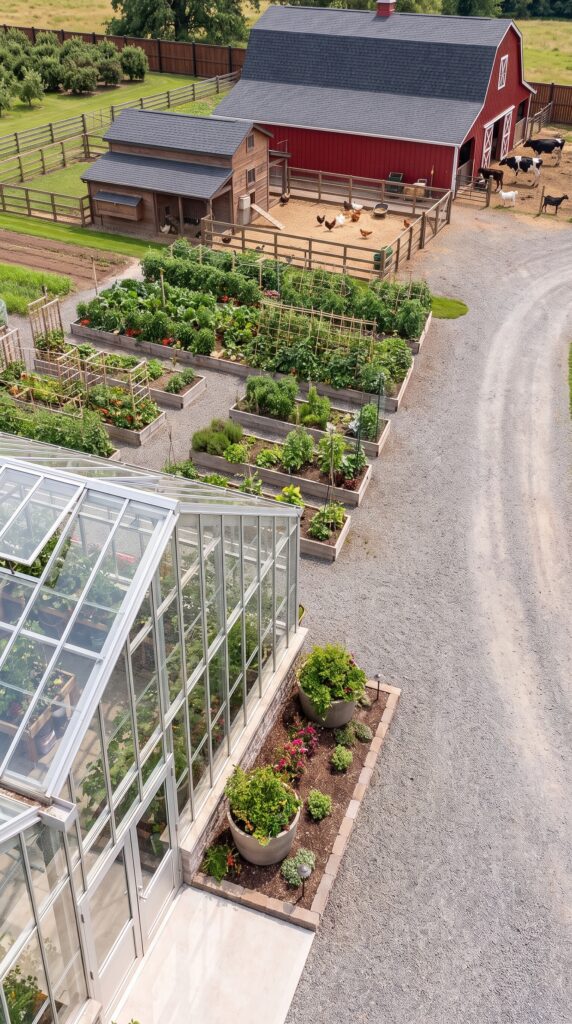
Outside the greenhouse is a large area of raised beds and open vegetable gardens.
Instead of a decorative garden, this section is designed for actual food production.
The layout can include potatoes, carrots, onions, beans, tomatoes, peppers, lettuce, cabbage, squash, herbs and other seasonal crops.
The cost is relatively small compared with the major structures because the basic components are soil preparation, irrigation, raised-bed construction, fencing, paths and planting.
Estimated budget: $20,000–$40,000.
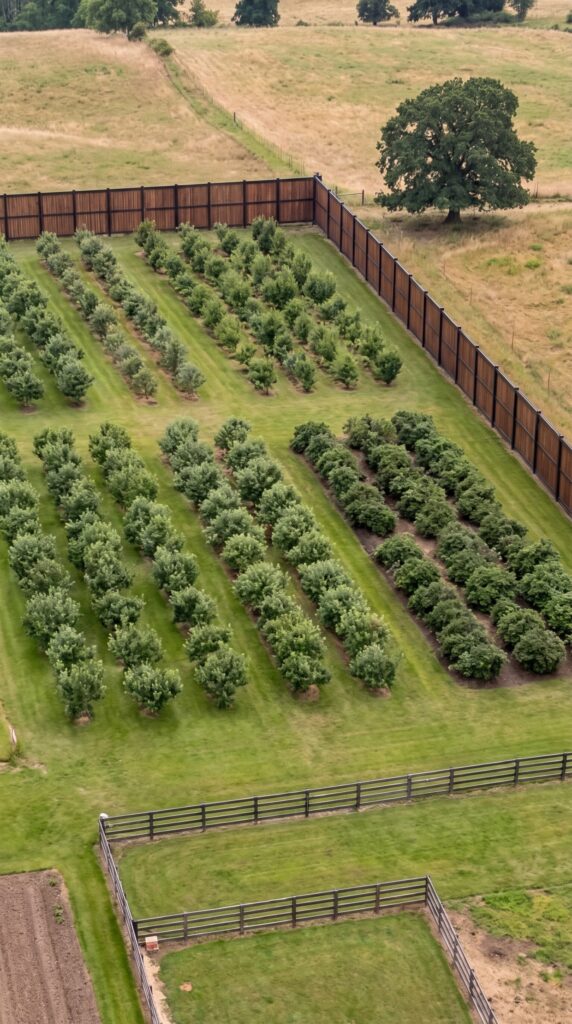
The Orchard and Berry Fields — $25,000–$50,000
Further from the house is a large orchard containing rows of fruit trees and berry bushes.
Depending on climate, the property could support apples, pears, peaches, plums, cherries, blueberries, raspberries and other crops suitable for the region.
The real expense is not simply buying the trees.
A productive orchard requires irrigation, soil preparation, tree supports, fencing, drainage and several years of maintenance before reaching full production.
Budget: $25,000–$50,000.
The Chicken Coop — $15,000–$30,000
The chicken area is intentionally much simpler than the main house and workshop.
The concept shows a practical agricultural building with an enclosed outdoor run.
A properly constructed coop can include nesting areas, ventilation, secure storage, automatic watering and feeding systems and predator-resistant fencing.
Estimated budget: $15,000–$30,000.
This is one of the areas where the property can remain relatively inexpensive while still providing a useful source of eggs and poultry.
The Livestock Barn — $100,000–$180,000
The large red barn is designed for larger animals and agricultural storage.
It can accommodate livestock stalls, hay, feed, equipment and covered working areas.
Basic pole-barn construction can be relatively inexpensive, with 2026 Georgia estimates around $14–$42 per square foot for basic structures, but a finished livestock barn with concrete, electrical, water, doors, stalls and specialized agricultural features will be substantially more expensive.
A realistic budget for the building shown is $100,000–$180,000.
The Equipment Shed — $18,000–$35,000
Near the workshop is a smaller equipment storage structure.
This is where smaller tractors, lawn equipment, trailers, attachments and maintenance tools can be kept.
Because it does not require the same finish level as the main workshop, the cost stays relatively low.
Estimated budget: $18,000–$35,000.
Firewood Storage — $7,000–$15,000
The covered firewood structure is another example of how the estate mixes expensive buildings with very simple infrastructure.
Its job is straightforward: keep a large supply of firewood dry and organized.
A well-built covered storage structure could realistically cost $7,000–$15,000.
The Root Cellar — $20,000–$45,000
One of the more interesting features is the underground root cellar.
It provides cool, stable storage for potatoes, onions, apples, canned goods and other foods that do not necessarily require refrigeration.
Compared with the main residence or workshop, this is a relatively inexpensive way to create additional food-storage capacity.
Estimated budget: $20,000–$45,000.
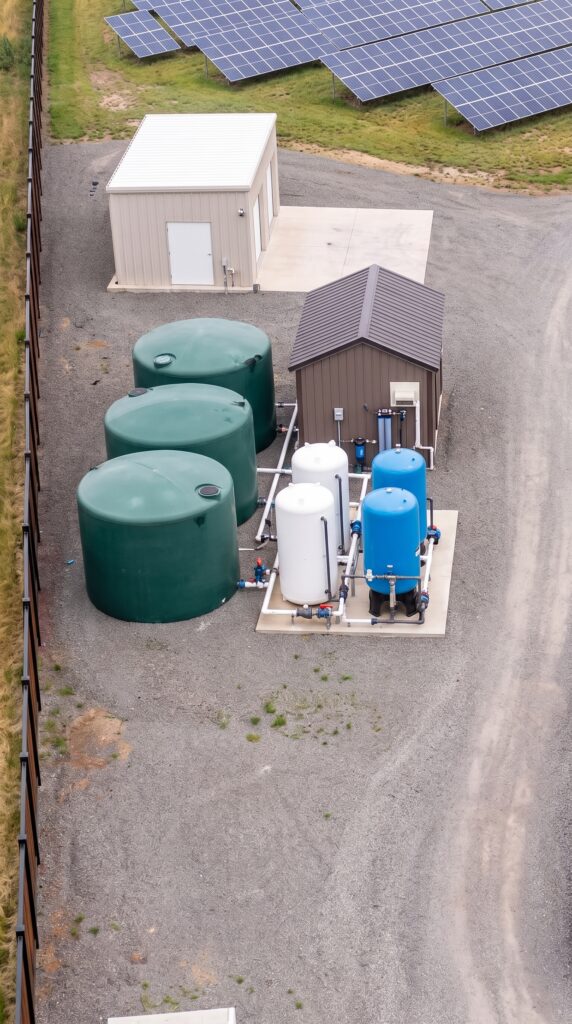
The Water System — $45,000–$85,000
The water infrastructure is one of the parts that can easily be overlooked when planning a large rural property.
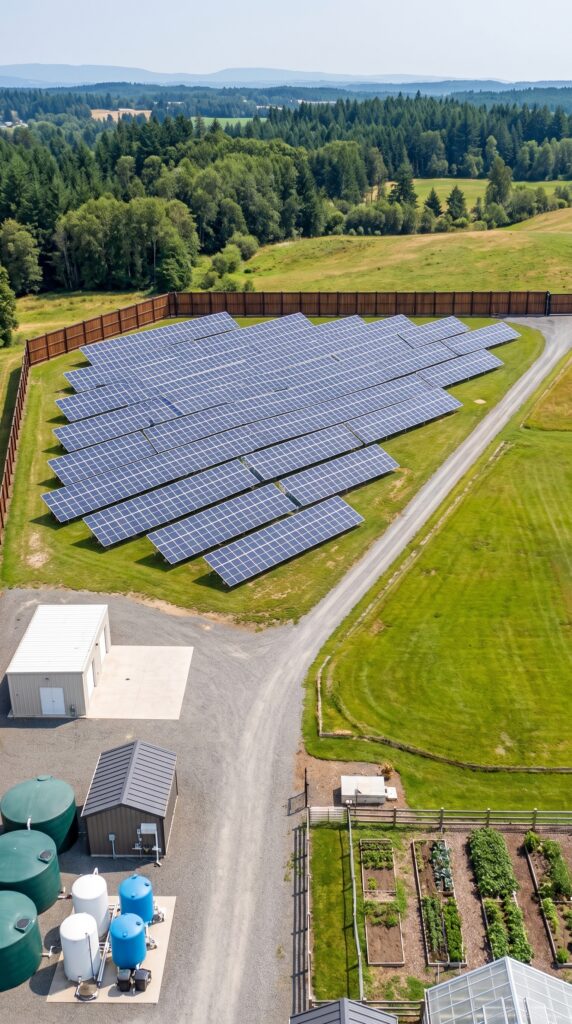
The concept includes multiple large storage tanks, water filtration and distribution infrastructure.
A rural well alone can cost thousands to tens of thousands of dollars depending on depth and geology; current U.S. estimates put a typical 200-foot well around $6,000–$16,000, with difficult sites going significantly higher. Septic, pumping, filtration, electrical connections, storage and distribution add to the total.
For a property of this scale, I would allocate $45,000–$85,000 for the overall water system.
That would cover the well, pumps, tanks, filtration, irrigation connections and related infrastructure.
The 50-kilowatt Solar Farm — $60,000–$90,000
The solar farm is one of the most valuable parts of the property.
Instead of placing a few panels on the roof, this design dedicates a large section of land to ground-mounted solar panels.
The planned capacity is approximately 50 kilowatts.
Large solar-farm installations are commonly estimated around $0.90–$1.30 per watt before land costs, meaning 50 kW would produce a rough equipment-and-installation baseline around $45,000–$65,000 before accounting for the additional engineering, ground-mount structure, site preparation and property-specific electrical infrastructure.
For this specific homestead, I would budget $60,000–$90,000.
One important detail: producing excess power does not automatically mean the owner can sell it for attractive rates. Compensation depends on the utility, state rules and interconnection agreement.
Battery Storage — $80,000–$150,000
A 50-kW solar array is much more useful when paired with substantial energy storage.
The battery system would allow daytime solar production to support the property after sunset and provide backup capacity during outages.
Current battery pricing varies dramatically by technology. EnergySage’s 2026 figures show installed battery costs commonly around $1,000+ per kWh in many U.S. markets.
For a large rural property, a substantial storage bank could therefore require approximately $80,000–$150,000.
Roads and Internal Driveways — $150,000–$300,000
The property contains much more than one driveway.
There are internal roads connecting the house, greenhouse, barn, workshop, solar area, guest house, pond and entrance.
These roads have to work during rain, snow and heavy equipment traffic.
The budget includes grading, gravel, drainage and selected hard-surface areas.
Estimated cost: $150,000–$300,000.
Perimeter Fence and Main Gate — $85,000–$160,000
The entire 12-acre property is enclosed by a substantial wooden privacy fence with a large decorative entrance gate.
At this size, the fence becomes a major construction project.
Current 2026 U.S. installed privacy-fence pricing is commonly around $20–$55 per linear foot, depending on material and design.
A roughly 3,000–3,500-foot perimeter could therefore represent tens of thousands of dollars before adding the upgraded main gate, stone columns, automation and landscaping.
For the complete perimeter system, I would use $85,000–$160,000.
Landscaping and Finished Grounds — $40,000–$80,000
The visual appeal of this property comes partly from how carefully the individual zones are connected.
The lawns, trees, garden paths, flower beds, stone borders and landscaped areas make the agricultural property feel more like a private estate.
Estimated budget: $40,000–$80,000.
Utility Distribution Across the Property — $60,000–$120,000
The main residence, guest house, greenhouse, barn, workshop, water system and agricultural buildings all need utilities.
Electric lines, water lines, drainage, communications, lighting and service panels have to be distributed throughout the property.
Estimated budget: $60,000–$120,000.
Design, Engineering and Permits — $180,000–$300,000
A project this complicated cannot realistically be designed like a normal house.
You have residential buildings, agricultural structures, a pool, pond, well, septic, solar generation, electrical distribution, roads and extensive site work.
Architects, structural engineers, civil engineers, surveyors, environmental consultants and permitting costs can therefore become a significant part of the budget.
Estimated allowance: $180,000–$300,000.
Construction Contingency — $200,000–$350,000
Large rural projects almost always encounter unexpected expenses.
Rock, poor soil, drainage problems, increased electrical requirements, longer utility runs, material price changes and site-access problems can all increase the final cost.
For a project of this scale, keeping a contingency of $200,000–$350,000 is much safer than assuming every line item will come in exactly as planned.
Full Estimated Construction Budget
Component
Estimated Cost
Main family residence
$650,000–$950,000
Guest house
$180,000–$300,000
Garage / workshop
$220,000–$380,000
Pool area
$70,000–$110,000
Private pond
$35,000–$75,000
Large greenhouse
$120,000–$220,000
Vegetable gardens
$20,000–$40,000
Orchard & berry fields
$25,000–$50,000
Chicken coop
$15,000–$30,000
Livestock barn
$100,000–$180,000
Equipment shed
$18,000–$35,000
Firewood storage
$7,000–$15,000
Root cellar
$20,000–$45,000
Well, tanks & filtration
$45,000–$85,000
50 kW solar farm
$60,000–$90,000
Battery storage
$80,000–$150,000
Roads & site preparation
$150,000–$300,000
Perimeter fence & gate
$85,000–$160,000
Landscaping
$40,000–$80,000
Utility distribution
$60,000–$120,000
Design & permits
$180,000–$300,000
Construction contingency
$200,000–$350,000
Estimated total: approximately $2.37 million–$4.05 million
A reasonable target for building something very close to the concept, without choosing the cheapest materials but also without turning every building into a luxury structure, would be approximately:
$3.1 million–$3.5 million
Land is not included.
For a rural 12-acre parcel, the land could add anywhere from a relatively modest amount in a low-cost agricultural market to several hundred thousand dollars in a desirable rural area.
Why This Property Is More Interesting Than a Normal Luxury Estate
The interesting part of this design is that the money is not concentrated entirely in the main house.
A significant portion of the budget is spread across infrastructure that can actually produce something.
The greenhouse can produce vegetables.
The orchard can produce fruit.
The berry fields can produce seasonal crops.
The chicken coop can provide eggs and poultry.
The barn can support livestock.
The pond can provide fish.
The well and storage system reduce dependence on municipal water.
The 50-kW solar installation can produce electricity.
The workshop allows the owner to repair equipment instead of sending everything to a contractor.
And the large amount of land gives the family room to expand the agricultural operation later.
That is what turns the property from an expensive country house into a genuine working homestead.
Could This Property Also Generate Income?
Potentially, yes.
The most obvious possibilities are agricultural production, nursery plants, greenhouse crops, eggs, meat, fruit, berries and other farm products.
The solar system could also potentially create value through electricity savings or export compensation, but that depends heavily on the local utility and the applicable state program. A 50-kW system should therefore not be treated as guaranteed passive income without checking the specific interconnection and compensation rules.
A second possibility is using part of the property for a small agricultural business while maintaining the main residence as a private family area.
That is where 12 acres becomes particularly interesting.
It is large enough to support a meaningful agricultural operation while still allowing the property to look and feel like a private estate.
The Final Picture
For around $3.1–$3.5 million excluding the land, this concept could become an enormous private family homestead with a custom residence, guest house, large workshop, greenhouse, livestock barn, chicken coop, orchard, berry fields, vegetable gardens, private pond, swimming pool, water-treatment system, root cellar, firewood storage and a 50-kW solar farm.
It is not designed simply to look impressive from the road.
Every major section has a purpose.
The house provides the comfort. The guest house provides flexibility. The greenhouse and gardens provide food. The orchard provides long-term production. The barn and chicken coop add livestock. The pond adds another food and recreation system. The workshop keeps the property operational. The well and tanks provide water infrastructure. The solar farm produces electricity. And the 12 acres give the entire system enough room to function without feeling overcrowded.
At that point, you are no longer looking at an ordinary American country home.
You are looking at a private family estate that functions like a small self-sufficient farm.
Would you spend around $3 million building something like this in the United States, or would you take the same money and build a much simpler house on a much larger piece of land?
This is an architectural concept visualization and not a real construction project.

Leave a Reply