

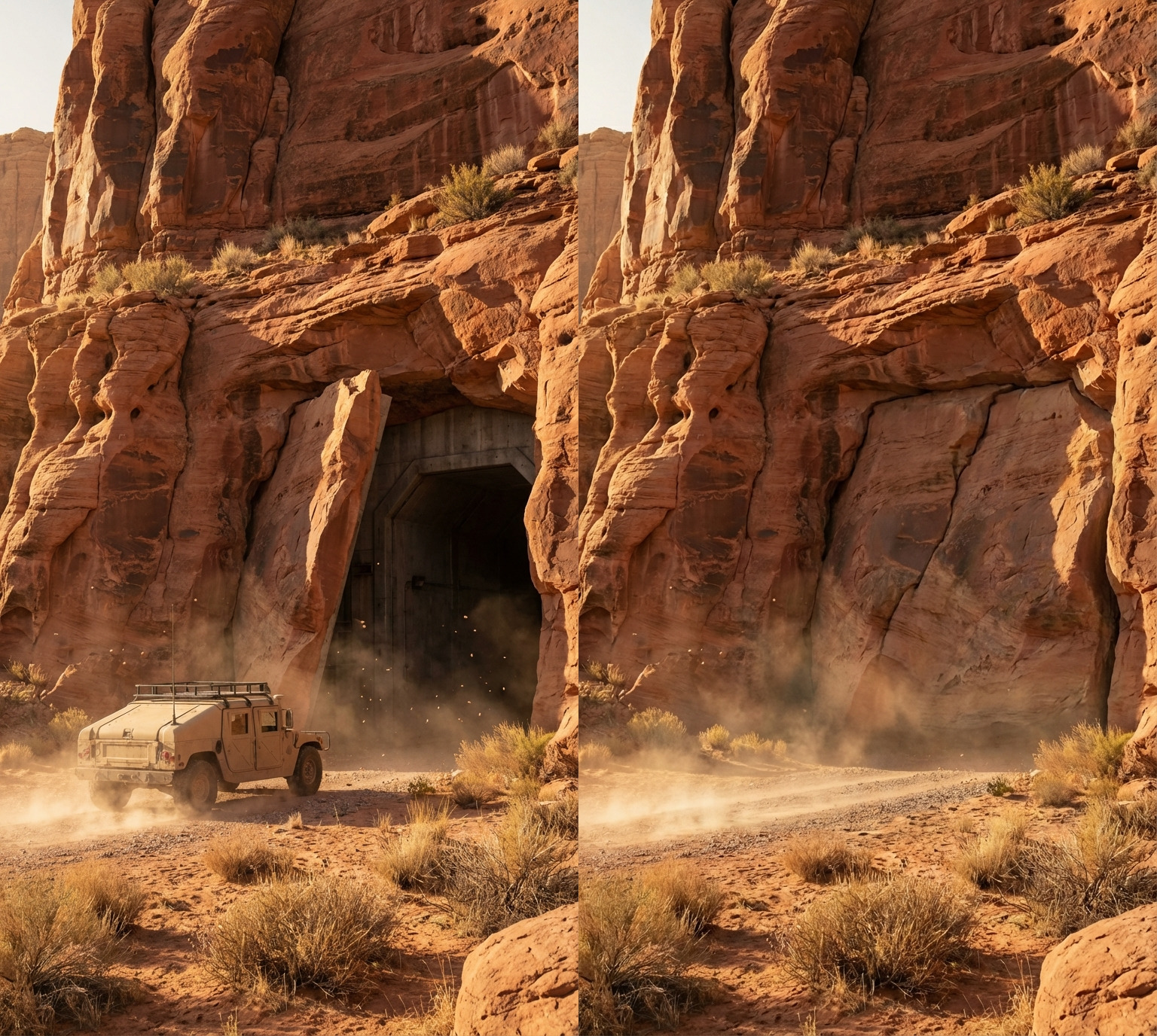
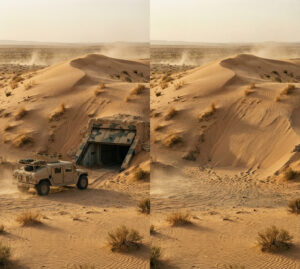
Carved directly into a massive desert rock formation, this bunker is designed to remain completely invisible until activated. From the outside, the cliff appears untouched — a natural canyon wall with no visible signs of human intervention.
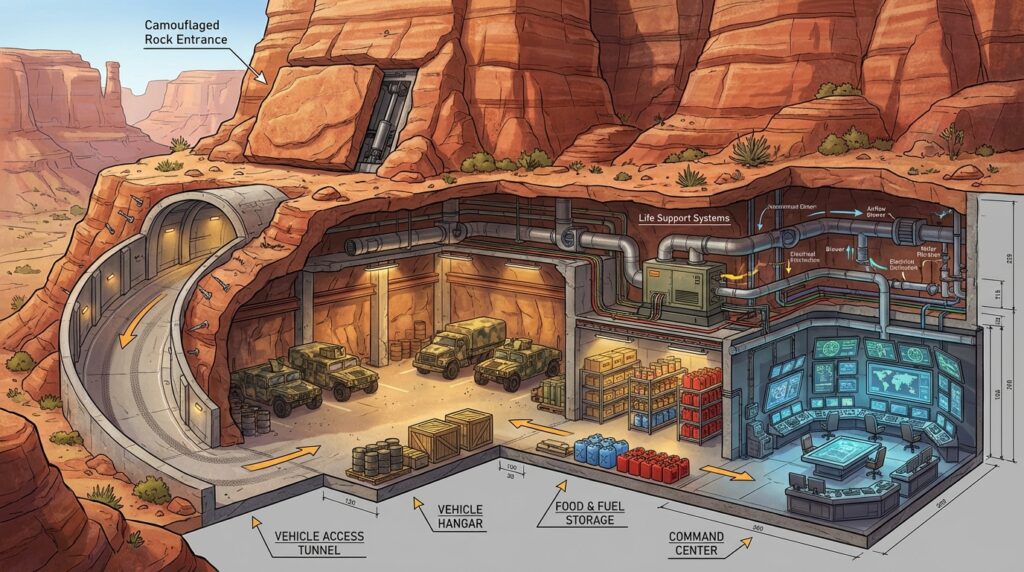
The entrance is hidden behind a perfectly engineered rock slab that blends seamlessly with the surrounding stone. When closed, the bunker is indistinguishable from the natural terrain. Once activated, the massive ???????? ????? smoothly slides open, revealing a reinforced tunnel entrance large enough for vehicles.
A concealed access road leads directly to the entrance, allowing off-road vehicles to approach without leaving obvious tracks. As the rock door opens, the bunker reveals a wide reinforced passage, enabling SUVs and military-style vehicles to drive inside quickly and safely.
Inside, the bunker extends deep into the rock, providing natural insulation, structural strength, and protection from external threats. The rock itself acts as a shield, reducing heat, noise, and visibility from outside.
This type of design combines natural camouflage with advanced engineering, creating one of the most secure and hidden bunker concepts possible. In a harsh desert canyon environment, the best hiding place is not underground alone — but inside the landscape itself.
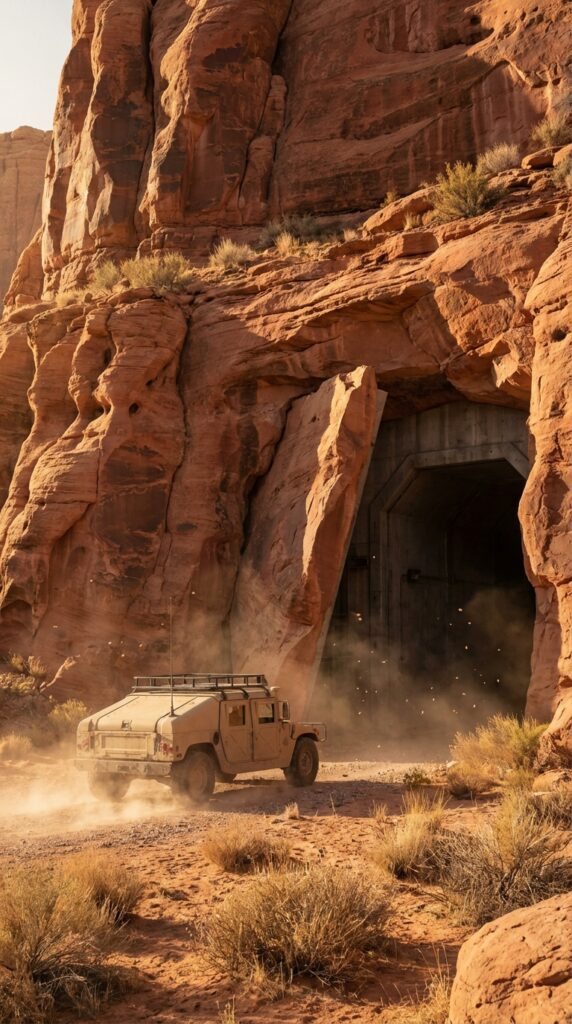

Inside the Hidden Desert Bunker BaseUnderground Rock Hangar: Vehicle Bay and Operational Core
Inside the massive rock formation, the bunker opens into a large underground hangar designed to support both transportation and long-term survival operations. Carved directly into the canyon and reinforced with steel beams and concrete structures, this space combines natural protection with engineered durability.
The main chamber functions as a vehicle bay, where multiple off-road vehicles are stored and maintained. These vehicles are always ready for rapid deployment, allowing occupants to move quickly through rough desert terrain when needed. The wide layout ensures easy maneuvering and fast exit through the concealed rock entrance.
Surrounding the vehicles, organized storage areas hold essential supplies including fuel containers, emergency equipment, and long-term rations. Everything is positioned for quick access, minimizing delays during critical situations.
The bunker’s infrastructure is integrated directly into the rock walls. Ventilation systems, electrical wiring, and control panels are built into reinforced channels, maintaining a clean and efficient layout while ensuring full functionality. Overhead lighting combined with natural light shafts creates a balanced environment, reducing the sense of isolation.
A dedicated control station monitors systems such as power, air circulation, and external surveillance, allowing full oversight of the bunker at all times. This makes the hangar not just a storage space, but the operational center of the entire facility.
Built deep inside solid rock, this environment provides natural insulation from heat, sound, and external threats. The combination of geology and engineering creates a highly secure, hidden, and fully functional underground base designed for survival in extreme conditions.
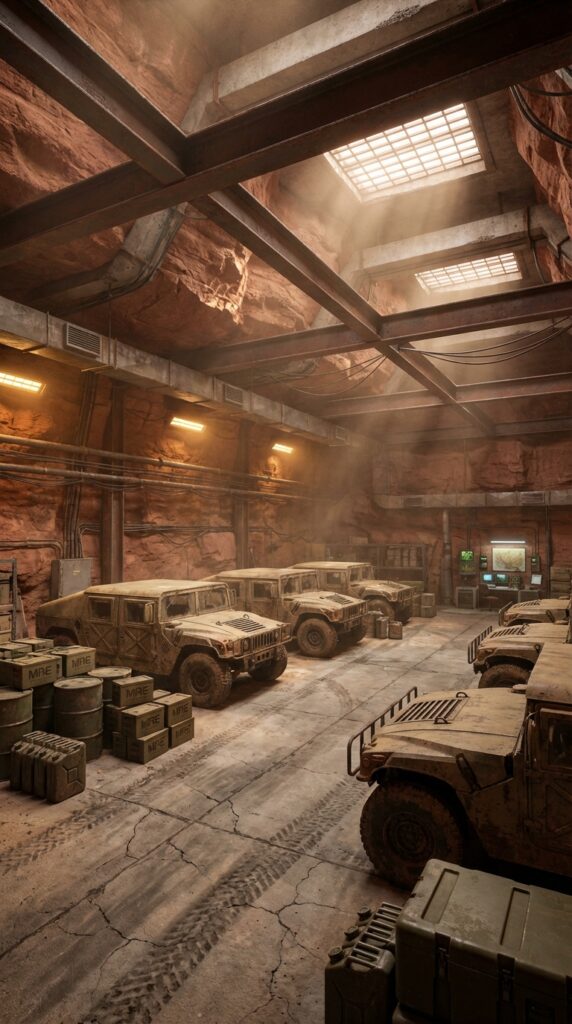
Command Center: Control, Monitoring, and Strategic Coordination
Deep inside the rock bunker, this dedicated command center serves as the operational brain of the entire facility. Designed for full situational awareness, the room is equipped with advanced monitoring systems that allow occupants to track activity both inside and outside the bunker in real time.
Multiple radar-style displays and digital screens provide constant data on surrounding movement, environmental conditions, and potential threats. These systems are supported by communication equipment, including radios and signal receivers, ensuring that the bunker remains connected even in isolated conditions.
A large wall-mounted map combined with tactical overlays allows for route planning, evacuation coordination, and resource management. This makes it possible to quickly respond to changing situations and make informed decisions under pressure.
All systems are integrated into a centralized control interface, allowing operators to manage power distribution, ventilation, security cameras, and internal infrastructure from a single point. This level of control ensures maximum efficiency and rapid response during emergencies.
The command center is also designed for continuous operation. Ergonomic workstations, organized equipment layout, and reliable power supply enable long-term monitoring without interruption.
Built directly into the rock and protected by reinforced structures, this space remains secure, quiet, and isolated from external interference. It is not just a monitoring room — it is the strategic core of the bunker, where every critical decision is made and every system is controlled.
Supply and Fuel Storage: Sustaining Long-Term Operations
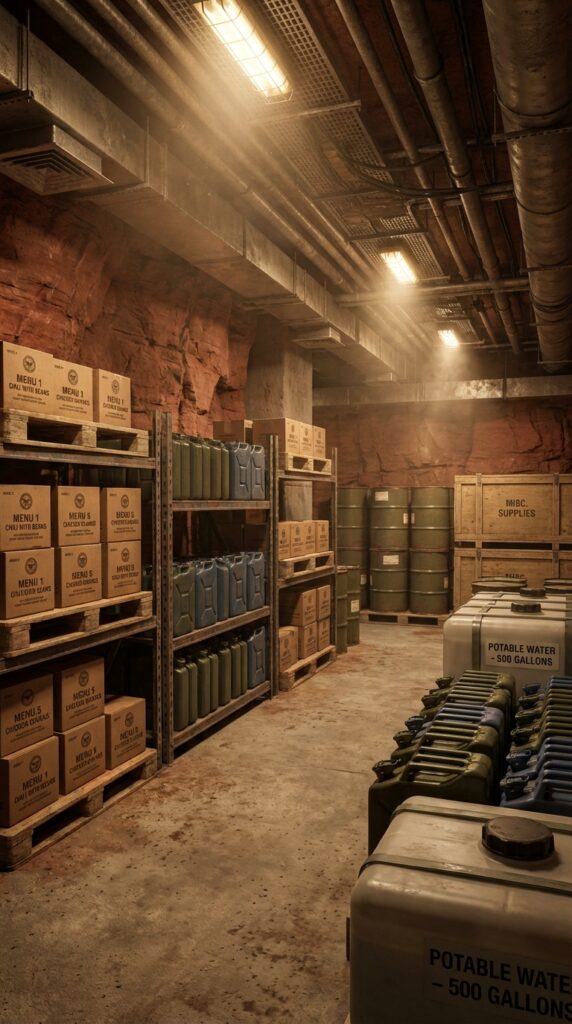
This section of the bunker is dedicated to storing essential supplies and fuel, ensuring long-term sustainability for all occupants. Designed for efficiency and quick access, the storage area is organized into clearly defined zones for food, water, and operational resources.
Shelving units are stocked with long-term food supplies, including canned goods, dry rations, and military-grade MRE packs. These are carefully arranged and rotated to maintain freshness and readiness. Large water containers provide a reliable source of clean drinking water, ???????????? to support occupants for extended periods.
Adjacent to the food storage area, fuel reserves are securely stored in reinforced containers. These supplies are critical for powering vehicles, generators, and essential equipment within the bunker. The storage system is designed with safety in mind, including proper ventilation and separation to reduce risk.
The layout allows for fast loading and distribution, ensuring that supplies can be quickly transferred to vehicles or living areas when needed. Everything is positioned for operational efficiency, minimizing delays in high-pressure situations.
This supply zone is a key component of the bunker’s overall system, providing the resources necessary to sustain life, maintain mobility, and support ongoing operations in even the most challenging environments.
Desert Underground Bunker – Full Concept & Estimated Cost
This hidden desert bunker is designed as a large-scale underground base built beneath a natural sand dune with a fully concealed vehicle entrance.
The project combines a reinforced concrete structure, a camouflaged armored hatch system, and a sand-dispersion mechanism that instantly covers the entrance, making it completely invisible from the outside.
Inside, the bunker features a massive underground hangar capable of storing multiple vehicles, including off-road trucks and armored units. The space is engineered with high ceilings, heavy structural support, and a layout optimized for quick deployment and efficient organization.
The interior includes:
— a large vehicle hangar (3 Hummer-size vehicles + 2 armored units)
— storage zones with food, water, and long-term supplies
— communication and surveillance control room
— ventilation and air filtration systems
— maintenance and equipment areas
The entire structure is built for durability, concealment, and long-term operation beneath harsh desert conditions.
Estimated Cost (Turnkey Project)
The total cost of building a bunker of this scale depends on location, materials, and level of equipment, but an approximate breakdown is:
— Excavation and ground preparation: $80,000 – $150,000
— Reinforced concrete structure (underground hangar): $250,000 – $450,000
— Armored vehicle entrance + hydraulic hatch: $120,000 – $250,000
— Sand camouflage and dispersion system: $40,000 – $90,000
— Ventilation and air filtration systems: $30,000 – $70,000
— Electrical systems and lighting: $20,000 – $50,000
— Storage systems, shelving, and layout: $15,000 – $40,000
— Surveillance, radar, and communication equipment: $40,000 – $120,000
Total Estimated Cost:
$600,000 – $1,200,000
This type of bunker is considered a high-end hidden survival base, combining large-scale underground construction with advanced concealment systems and full operational capability.
Architectural visualization. It is not a real construction project.
Leave a Reply